How to Wear Seamless Shapewear Without Rolling

Table of Contents
- Why Seamless Shapewear Rolls and How to Stop It
- Why Does Shapewear Roll Down? Root Causes You Can Fix
- How to Put On Shapewear Correctly (Step-by-Step)
- High-Waisted Shapewear That Stays in Place: What to Look For
- How to Stop Shapewear from Rolling Up at the Thighs
- Body-Type Adjustments: Torso Length, Curves, and Fit Tweaks
- Post-Wash Care and Outfit Pairing for All-Day Wear
- Conclusion: Wear Seamless Shapewear with Confidence
- Frequently Asked Questions
Last Updated: October 8, 2026
Why Seamless Shapewear Rolls and How to Stop It
Seamless shapewear is body-shaping underwear knit as one continuous piece, with no side seams or stitched panels. That smooth construction is why it disappears under clothes, and why it rolls.
At SheRoar by Black Lion, we hear the same complaint again and again: the shapewear looked perfect for ten minutes, then started creeping. Below, we explain how to wear seamless shapewear without rolling, using fixes that address the real causes.
The Real Causes: Sizing, Fabric, and Body Mechanics
Rolling almost never comes from one bad garment. It comes from three things working together.
- Wrong size. A band that is too loose slides. A band that is too tight digs in and curls over.
- Fabric memory. Cheap knits stretch out fast and never bounce back to their original shape.
- Body mechanics. Sitting, bending, and walking all push fabric in different directions. A band that sits on a crease will fold along that crease.
Fix all three and the rolling stops. Fix only one, and it returns by lunchtime.
Why Does Shapewear Roll Down? Root Causes You Can Fix
Shapewear rolls down when the waistband is not anchored to a stable part of your torso. The band needs to sit on the narrowest part of your waist, not your ribs, not your hips.
Here is what actually pushes a waistband down:
- A band that sits too high. Above the natural waist, your ribcage widens as you breathe. The band gets pushed down with every inhale.
- A band that sits too low. On the hips, the band rides up when you sit, then folds when you stand.
- Smooth, slippery fabric underneath. Silk, satin, and some activewear fabrics give the band nothing to grip.
- A short torso. If your torso is short, a high-waist piece may reach your bra band. Two bands fighting each other always end in a roll.
- Stretched-out elastic. Elastic loses its memory over time. A band that used to grip will start to slide.
The fix is not more compression, but better placement and a band that still has its stretch.
How to Put On Shapewear Correctly (Step-by-Step)
Most people put shapewear on like regular underwear. That is the mistake. Seamless pieces need to be rolled on and anchored, like compression socks, so tension spreads evenly across the band and no single point curls.
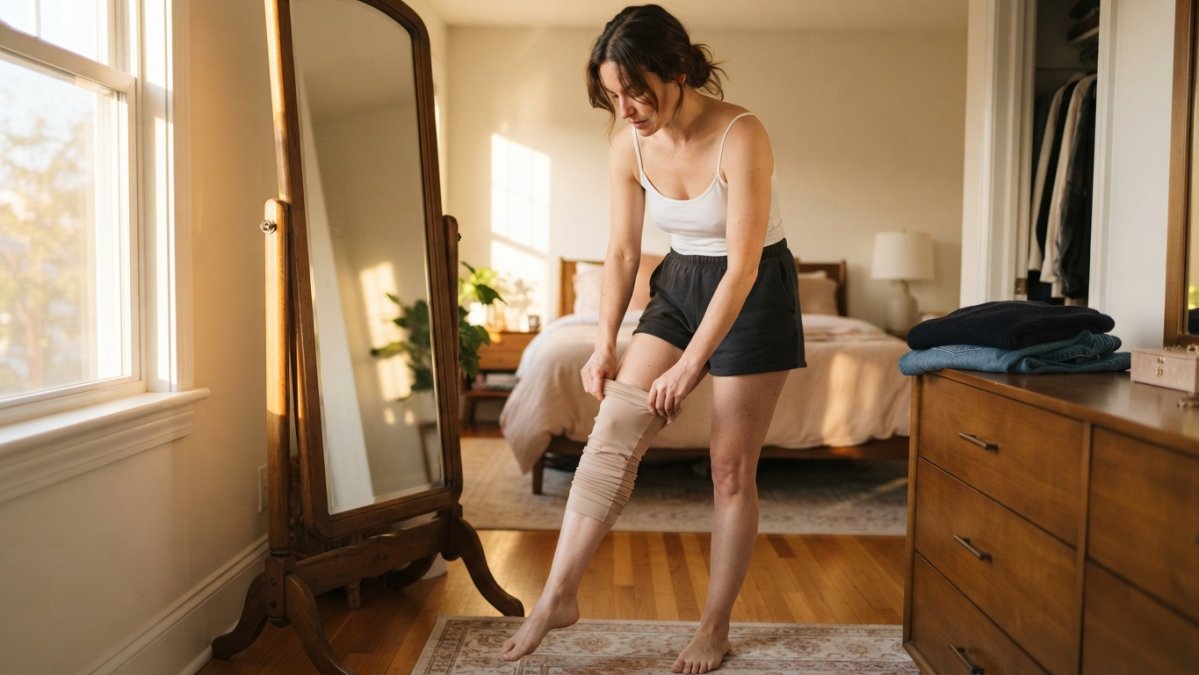
Here is the method we recommend.
Step 1: Prep Your Skin and Underwear Line
Start with dry, lotion-free skin. Moisturizer and body oil make fabric slide, and a sliding band rolls, so skip lotion on your waist and thighs on shapewear days.
Next, decide what goes underneath. Thin cotton underwear adds a layer that can bunch; most seamless pieces are designed as your only layer. If you prefer a panty liner, choose a smooth, low-profile edge rather than a raised quilted one that creates a ridge under the knit.
Step 2: Roll, Step In, and Anchor the Waistband
- Turn the waistband down and out, like you are peeling a sock halfway off.
- Step into the leg openings and pull the rolled band up to your knees.
- Work the fabric up in small sections, a few centimetres at a time. Do not pull from the waistband; pull from the fabric below it so the band stays relaxed.
- Stop at your natural waist, the narrowest point between your ribs and hips. If you are unsure where that is, bend sideways; the crease that forms is your natural waist.
- Press the band flat against your skin with both hands and hold for a few seconds. Then run your thumbs along the top edge, pressing it down and slightly inward, so the band grips rather than sits on top of the skin.
That last press matters more than people think: it helps the anti-slip grip settle against your skin before you move. Women who skip it often find the band rolls within the first hour.
Step 3: Adjust the Leg Openings and Smooth the Fabric
Once the waist is set, check the leg openings. Slide two fingers under each and lift the fabric so it sits flat on your thigh, not folded.
If the leg openings still roll after this, the issue is usually the cut, not the application. A flat-angle leg cut sits flush against the thigh and resists rolling better than a traditional folded hem.
Step 4: Do a Movement Check Before You Leave
Before you leave, sit down, stand up, and bend forward once. If the band shifts, adjust it now rather than fighting it later. A band that stays put through this check usually stays put all day.
High-Waisted Shapewear That Stays in Place: What to Look For
High-waisted shapewear that stays in place has three things in common: a wide band, a knit with good recovery, and a cut that matches your torso length.
Look for these features before you buy:
| Feature | Why It Matters | What to Avoid |
|---|---|---|
| Wide waistband | Spreads pressure, grips better | Thin elastic bands |
| Circular-knit fabric | Stretches in all directions, recovers | Flat panels with stitched seams |
| Laser-cut edges | Lie flat, no bulky hems | Thick folded hems |
| Anti-slip inner band | Adds grip without tightness | Slick, shiny linings |
| Correct torso length | Sits at the natural waist | Bands that reach your bra line |
Circular knitting is the detail most shoppers skip.
Our guide to textile stretch and recovery testing explains how recovery is measured, and it is worth understanding before your next purchase.
For a high-waist option built around this idea, our Powerful Tummy Control High-Waist Seamless Postpartum Shaping Safety Underwear uses a high-waist cut with a tummy control panel and a seamless thin nylon knit.

How to Stop Shapewear from Rolling Up at the Thighs
Thigh rolling has a different cause than waist rolling: a leg opening too narrow for your thigh, or fabric that has lost its stretch.
Try these fixes:
Tummy Control Butt Lift Seamless Briefs | Mesh Shapewear Panties →
- Check the leg opening. It should sit flat with no digging. If it leaves a deep mark, the piece is too small.
- Look for a flat-angle leg cut. A cut that sits flush against the thigh will not ride up under skirts or dresses.
- Use a light layer of anti-slip spray or fashion tape on the inner thigh for slippery fabrics.
- Try a longer short. A boyshort or mid-thigh cut has more fabric to grip than a brief.
- Replace stretched pieces. If the leg bands have gone slack, no technique will fix them.
Our High Waist Shaper Boyshorts use a boyshort cut with a high-rise waistband and a nylon/spandex stretch mesh. The full coverage cut removes visible panty lines, and the firm compression holds without rolling or digging.
Body-Type Adjustments: Torso Length, Curves, and Fit Tweaks
The same shapewear behaves differently on different bodies.
Short torso: Choose a mid-rise piece instead of high-waist. Our Tummy Control Butt Lift Seamless Briefs use a mid-rise cut designed for this.

Long torso: A high-waist piece may sit below your bra line, which is ideal.
Fuller hips and thighs: Size to your hip measurement, not your waist. Our High Waist Shaper Boyshorts are cut to fit hips and thighs without pinching.
Straight or athletic build: You may need a piece with more grip, since there are fewer curves for fabric to hold onto.
Postpartum: Choose gentle, wide-band support rather than firm compression, your body is still changing, and a band that fits today may not fit next month. Our High-Waist Tummy Control Safety Shorts use this flat-angle cut.

Apple shape (fuller midsection): The band should sit at your natural waist, which may be higher than you think.
Hourglass shape: You have a defined natural waist, so a band that sits there will stay put.
Women who match the garment's rise to their torso length and the leg cut to their thigh shape stop fighting rolling altogether. The fix is not more compression; it is better geometry.
Post-Wash Care and Outfit Pairing for All-Day Wear
How you wash shapewear decides how long it keeps its grip. Heat is the enemy.
Wash by hand in cool water with mild detergent, or machine-wash in a mesh bag on delicate. Never use the dryer, lay it flat to dry, away from direct sun.
Then think about what you wear over it:
- Under leggings: Choose a seamless brief or boyshort so no lines show through.
- Under a slip dress: A high-waist short gives coverage and stops thigh rub.
- Under tailored trousers: A laser-cut edge lies flattest under woven fabrics.
- Under workout gear: Skip heavy compression and choose a breathable knit.
One more tip: match your shapewear color to your outer clothing, not your skin tone. Dark shapewear under light fabric can still show as a shadow.
Conclusion: Wear Seamless Shapewear with Confidence
Rolling shapewear is a solvable problem, and it rarely needs a new wardrobe. Check your size, anchor the band at your natural waist, and care for the fabric so it keeps its stretch.
At SheRoar by Black Lion, we build shapewear for women who move through the whole day, not just the mirror check.
See Catalog and find the fit that works for your body.
Frequently Asked Questions
How do I stop my shapewear from rolling down?
Start with the right size. Shapewear that is too small or too large will roll. Measure your waist and hips, then check the brand's size chart. SheRoar by Black Lion notes their items run one size smaller than US/EU, so size up for a true fit. Put the garment on by rolling it up your legs, then anchor the waistband flat against your skin. Smooth the fabric upward so it lies flat, not bunched. If it still rolls, try a high-waisted style with a wider band, like the Powerful Tummy Control High-Waist Seamless Postpartum Shaping Safety Underwear.
Is there any shapewear that doesn't roll?
No garment stays perfectly still on every body, but some designs resist rolling better. Look for wide, high-rise waistbands that sit above the natural waist, laser-cut or seamless edges, and stretch mesh or nylon/spandex blends that hold shape. The High Waist Shaper Boyshorts use a high-rise waistband and stretch mesh to stay put without digging. Fit matters more than brand: a size that matches your measurements will always outperform a tighter one. If you are between sizes, size up.
How do I put on shapewear correctly?
Roll the garment down to the waistband, step into the leg openings, and pull it up gradually. Do not yank it up all at once. Once it is over your hips, anchor the waistband with both hands and smooth the fabric upward so it sits flat. Adjust the leg openings so they lie flush against your thighs. If you use fashion tape, apply it to clean, dry skin along the waistband edge. A slow, even application prevents the bunching that leads to rolling later in the day.
Can the wrong size make shapewear roll?
Yes. A size that is too small creates tension that pushes the waistband down. A size that is too large leaves extra fabric that folds and rolls. Both problems come from guessing instead of measuring. Use a soft tape measure around your natural waist and fullest hip, then compare to the size chart. SheRoar by Black Lion recommends sizing up because their items run one size smaller than US/EU. If you are between sizes, choose the larger one for comfort and staying power.