Is 4-Way Stretch Fabric Worth the Investment?

Table of Contents
- Why 4-Way Stretch Fabric Costs More Up Front
- 4-Way Stretch Fabric vs 2-Way Stretch: What Actually Changes
- Where 4-Way Stretch Earns Its Price: Fit, Recovery, and Range of Motion
- The Best Fabrics for HIIT Workouts and High-Impact Training
- An Activewear Fabric Care Guide That Protects Your Spend
- Cost-Per-Wear: The Real Math Behind the Investment
- When 4-Way Stretch Is Not Worth It
- Frequently Asked Questions
Last Updated: September 14, 2026
Why 4-Way Stretch Fabric Costs More Up Front
Walk into any activewear aisle and you'll notice a price gap between garments that look nearly identical on the hanger. The difference usually comes down to one spec: 4-way stretch fabric. This guide from SheRoar by Black Lion explains what that label buys you.
4-way stretch fabric is a knit textile engineered to stretch in four directions: crosswise, lengthwise, and along both diagonals. That multi-directional movement separates a legging that recovers its shape after a squat from one that sags by week three.
The cost premium is real, and it's not marketing fluff. Producing a knit that stretches and recovers on both the warp and weft axes requires more elastane, tighter textile engineering tolerances, and slower production runs. According to Textile Exchange's materials overview, elastane content and knit construction are two of the biggest drivers of performance apparel cost. You're paying for fiber content and construction, not a logo.
4-Way Stretch Fabric vs 2-Way Stretch: What Actually Changes
The core difference is directional stretch. 2-way stretch fabric stretches in one direction, usually crosswise, while 4-way stretch fabric stretches both crosswise and lengthwise with recovery in each direction.
Here's how the two compare in practice:
| Feature | 2-Way Stretch | 4-Way Stretch |
|---|---|---|
| Stretch direction | Crosswise only | Crosswise and lengthwise |
| Range of motion | Limited in deep bends | Full multi-directional movement |
| Recovery after wear | Slower, can bag out | Snaps back faster |
| Seam stress | Higher at stress points | Distributed more evenly |
| Best for | Light activity, casual wear | HIIT, yoga, lifting, daily wear |
| Typical feel | Firmer, less giving | Softer, more body-adaptive |
How to Tell Which One You Are Holding
Stretch the fabric across the width, then along the length. If it only gives in one direction, it's 2-way; if it gives in both, it's 4-way stretch.
A second test: pull the fabric diagonally. A true 4-way knit gives on the bias, letting a legging move with a lunging leg instead of pulling against it. Elastane above roughly 15% usually signals a 4-way knit, though construction matters as much as percentage (Checking your browser).
Where 4-Way Stretch Earns Its Price: Fit, Recovery, and Range of Motion
Four-way stretch earns its cost in three areas: fit retention, fabric recovery, and unrestricted range of motion. The mechanism behind each separates a real performance fabric from a marketing claim.

The Mechanism Behind Fit Retention
A 2-way knit accommodates movement in one plane only. When you squat or twist through a rotational lift, the fabric borrows stretch by pulling at the seams. A 4-way knit distributes that load across the whole panel because the yarns shift on both the warp and weft axes.
That load distribution protects the seams. In a 2-way knit, the seam is the weakest point, which is why cheaper leggings fail at the crotch, inner thigh, or waistband before the fabric wears out. In a 4-way knit, the fabric absorbs the stress.
Recovery Is the Quieter Benefit
Elastane fibers properly knit into a 4-way construction return to their original shape after stretching, keeping leggings fitting like leggings after a year of washes. Lower-quality 2-way knits lose elasticity and feel loose in places they never were.
Recovery speed matters as much as recovery itself. Between explosive movements, elastane must snap back before the next rep; if it doesn't, the fabric stays stretched and feels loose where it was stressed hardest. Higher elastane content and a denser knit shorten that recovery window.
Why Squat-Proof Leggings Depend on Crosswise Stretch
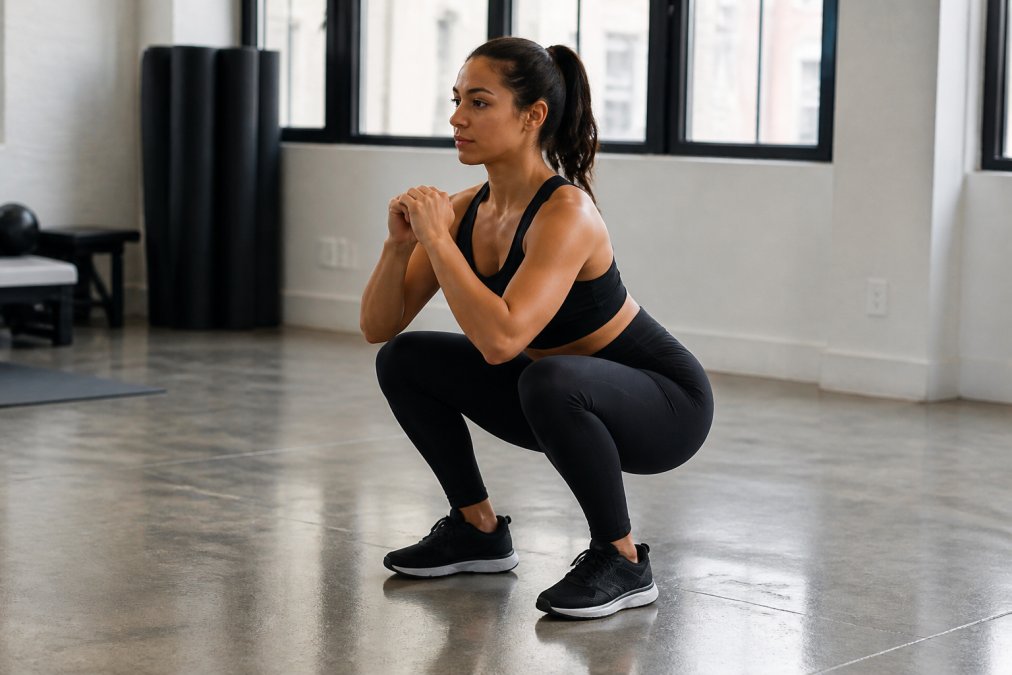
Squat-proofing is a crosswise stretch problem. At the bottom of a squat, the fabric across your seat is under maximum tension; a 2-way panel thins out and goes sheer, while a 4-way knit holds opacity because the yarns don't separate enough to show skin. That's the mechanical reason a squat-proof legging is squat-proof.
Opacity under tension is also a function of knit density. A denser knit with the same elastane content stays opaque under more tension, which is why two leggings with identical fiber tags can behave very differently in a deep squat.
The Longevity Math: Why This Is an Investment, Not a Purchase
The real case for 4-way stretch isn't how it feels on day one but how it performs on day three hundred. A garment that holds its shape, opacity, and fit through a year of training does something a cheaper 2-way knit structurally cannot, because that knit loses elasticity from the first wash.
That's the concrete link between fabric spec and cost-per-wear. The premium pays for a construction that resists the failure modes, bagging out, going sheer, losing recovery, that retire cheaper garments early. For consistent trainers, that's the difference between one purchase and three.
The Best Fabrics for HIIT Workouts and High-Impact Training
HIIT is the most demanding test a stretch fabric can face. A single session moves through deep squats, jump lunges, burpees, kettlebell swings, and rotational core work in under thirty minutes, so the fabric must stretch, recover, and stay opaque across every plane of motion without rest. That's why 4-way construction matters more here than in almost any other discipline.
What Actually Happens to Fabric During HIIT
In a jump squat, the knit across your seat and thighs is under maximum crosswise tension; in a kettlebell swing, the same panel is under diagonal tension. A 2-way knit accommodates only one of those loads, so the other is absorbed by seam allowance, which is why cheaper leggings pull at the crotch and waistband during rotational work. A 4-way knit distributes the load across the whole panel.
Recovery speed is the second mechanism. Between explosive movements, elastane fibers must snap back to resting length before the next rep; if they don't, the fabric stays stretched and feels loose where it was stressed hardest. Higher elastane content and a denser knit shorten that recovery window.
Matching the Fabric Spec to the Workout
Not every high-impact style needs the same construction. Experienced athletes match the fabric spec to the discipline:
- HIIT and plyometrics: Look for a polyester or nylon base with elastane in the mid-to-high teens, a dense knit that stays opaque under tension, and flatlock or bonded seams. The priority is recovery speed and opacity under load.
- Heavy lifting and powerlifting: Prioritize a slightly heavier knit with a firm hand feel. The fabric needs to resist deformation under a barbell and not slide against the skin during a heavy pull. A high-waist band that stays flat through hip hinges matters more here than maximum stretch.
- Yoga and pilates: Prioritize softness and body-adaptive fit over maximum recovery. A lighter 4-way knit with a brushed hand feel works well because the movement is controlled and the fabric is rarely under explosive tension.
- Running and trail: Prioritize moisture-wicking and chafe resistance. Flatlock seams and a fabric that doesn't cling when wet matter more than squat-proof opacity.
- Hiking and outdoor wear: Prioritize abrasion resistance and UV-friendly construction. A denser 4-way knit with a nylon base tends to hold up better against rock and brush than a lightweight polyester blend.
- Everyday and travel wear: Prioritize wrinkle resistance and shape retention across long days. A mid-weight 4-way knit that doesn't bag out at the knees or seat is the practical choice.
The Specs That Matter Most for High-Impact Training
When reading a fabric tag or product page, check these details:
- Elastane content, higher percentages generally mean faster recovery, but construction matters as much as the number. A well-knit fabric with moderate elastane can outperform a loosely knit fabric with more.
- Base fiber, polyester and nylon are the two workhorses. Polyester tends to wick faster; nylon tends to feel softer and resist abrasion better.
- Knit density, a denser knit holds opacity under tension and resists pilling. A lightweight knit feels great in the fitting room and wears out faster under high-impact use.
- Seam construction, flatlock or bonded seams reduce bulk and chafe. Overlocked seams on a stretch knit can pucker and fail at stress points.
- Waistband engineering, a wide, flat, high-waist band that stays put through burpees and jump squats is a functional spec, not a style choice.
Why This Matters for the Investment Question
If you train HIIT several times a week, the fabric spec is the difference between a garment that still fits like day one after a year and one that has bagged out at the knees and seat by month four. That's the concrete link between fabric choice and cost-per-wear, and why a higher-spec 4-way knit tends to be the better buy for high-impact training.
An Activewear Fabric Care Guide That Protects Your Spend
If you've paid a premium for 4-way stretch, your washing habits decide whether it lasts one season or several. Elastane is the fragile part, and heat plus harsh detergent kills it.
Wash, Dry, and Storage Habits That Preserve Elastane
Follow these habits to protect the stretch fibers:
- Turn garments inside out before washing to reduce surface abrasion
- Wash in cold water, never hot, to slow elastane breakdown
- Skip fabric softener, which coats fibers and reduces stretch recovery
- Use a mesh laundry bag to limit friction against zippers and hooks
- Air dry flat or hang, and avoid the dryer entirely
- Store folded rather than on hangers to prevent shoulder and waistband distortion
The dryer is the single biggest threat. Heat breaks down elastane, and once the fiber loses its snap-back, no amount of careful washing restores it. Air drying takes longer but it's the difference between a garment that lasts and one that doesn't.
Cost-Per-Wear: The Real Math Behind the Investment
Cost-per-wear is the price of a garment divided by how many times you wear it. It settles the "is it worth it" question, and it almost always favors the higher-quality piece.
Run the math on a real example. Leggings at $50 worn twice a week for two years work out to roughly 50 cents per wear. A cheaper pair at $25 that loses its shape after four months works out to well over a dollar per wear, because the wear count is so much lower.
The 4-way stretch garment wins on cost-per-wear for three reasons:
- It lasts longer before losing fit retention
- It stays wearable for more occasions because it doesn't bag out
- It resists the pilling and thinning that push cheap knits into the discard pile
That third point is the one most shoppers miss. The real cost of a cheap legging isn't the purchase price, it's the replacement cycle.
When 4-Way Stretch Is Not Worth It
Four-way stretch isn't worth the premium for light, low-impact use, or if you're still figuring out whether you'll stick with a routine.
Skip the premium in these cases:
- Casual lounging only. If the garment never sees a squat, 2-way stretch is fine.
- You're testing a new workout style. Buy one affordable pair first, then invest once you know you'll keep going.
- The garment is a trend piece. If you'll wear it for one season, the longevity argument falls apart.
- The fit is wrong anyway. No fabric spec rescues a garment that doesn't fit your body.
There's also an environmental angle worth naming. Elastane is a synthetic fiber, and synthetic stretch fabrics shed microplastics during washing. research on microplastic shedding from synthetic textiles has documented how much fiber a single wash can release. Buying fewer, longer-lasting garments is one of the more practical ways to reduce that impact, which is another point in favor of the investment when you'll actually wear the piece hard.
The real question isn't whether 4-way stretch fabric costs more. It's whether you'll wear the garment enough to earn that cost back. For women who train consistently, the answer is usually yes, and the fit retention, recovery, and squat-proof opacity make the difference obvious within the first month.
SheRoar by Black Lion builds its activewear around that principle, with four-way stretch construction, high-waist sculpting bands that stay flat through core work, and squat-proof polyester-spandex blends designed for both intense sessions and daily wear. New styles drop weekly, and the SheRoar Fitness resources give you workout videos and tips to get more out of every piece. Get started with SheRoar by Black Lion and dress the woman you are becoming.

Frequently Asked Questions
Is 4-way stretch fabric more durable than 2-way stretch?
Not automatically. Durability depends on fiber content, knit density, and how much elastane is blended in. A well-made 4-way stretch knit resists seam stress because the fabric gives in both directions instead of pulling on the stitches, which is why it tends to outlast 2-way stretch in high-movement areas like the seat and inner thigh. Cheap 4-way fabric with low spandex content can still thin out or pill within months. Check the label for a polyester-spandex blend and a dense, opaque knit before assuming stretch equals longevity.
Does 4-way stretch fabric lose its shape over time?
It can, and elastane is usually the reason. Heat, chlorine, and fabric softener break down spandex fibers faster than normal wear does. Wash in cold water, skip the dryer, and avoid softener, and a quality 4-way stretch garment will hold its fit retention for years rather than months. If leggings start bagging at the knee or waistband within a few washes, the fiber content was likely too thin to begin with, not the stretch construction itself.
How can I tell if a fabric has 4-way stretch before buying?
Stretch a small section of the fabric in two directions. If it gives both crosswise (side to side) and lengthwise (up and down), it is 4-way. If it only gives one way, it is 2-way. Online, check the product description for terms like four-way stretch, spandex or elastane percentage, and squat-proof. A blend with roughly 15 to 20 percent spandex usually signals real multi-directional movement rather than a marketing claim.
Is 4-way stretch fabric worth it if I am just starting my fitness journey?
Yes, for two reasons. First, a garment that moves in every direction reduces the chance of see-through fabric or a rolling waistband during your first classes, which matters when confidence is still building. Second, cost-per-wear favors it. A pair of high-waist sculpting yoga pants at $50.99 that lasts two years of weekly training costs far less per session than three cheaper pairs that sag or go sheer within a season. Buy fewer pieces that hold up.