How to Start Weightlifting for Women: Beginner Guide

Table of Contents
- Why Weightlifting Is Worth Starting Now
- Your Women's Beginner Strength Training Routine
- How Much Weight Should a Beginner Lift?
- How Many Days a Week Should Beginners Lift Weights?
- Beginner Dumbbell Workout for Women
- Learning Proper Form Before You Add Load
- Tracking Progress Beyond the Scale
- Conclusion
- Frequently Asked Questions
Last Updated: October 17, 2026
Why Weightlifting Is Worth Starting Now
Starting weightlifting for women as a beginner can feel intimidating, but it is one of the most effective ways to build strength and confidence.
Here is the most important thing to know up front: you do not need to be fit, young, or experienced to begin.
Strength training is not just about muscle. According to the CDC's physical activity guidance, adults should include muscle-strengthening activities at least two days a week.
Below, we break down the exact routine, weights, and weekly schedule we recommend to women starting out.
Your Women's Beginner Strength Training Routine
A women's beginner strength training routine should be simple, full-body, and repeated often. Skip the complicated splits you see online.
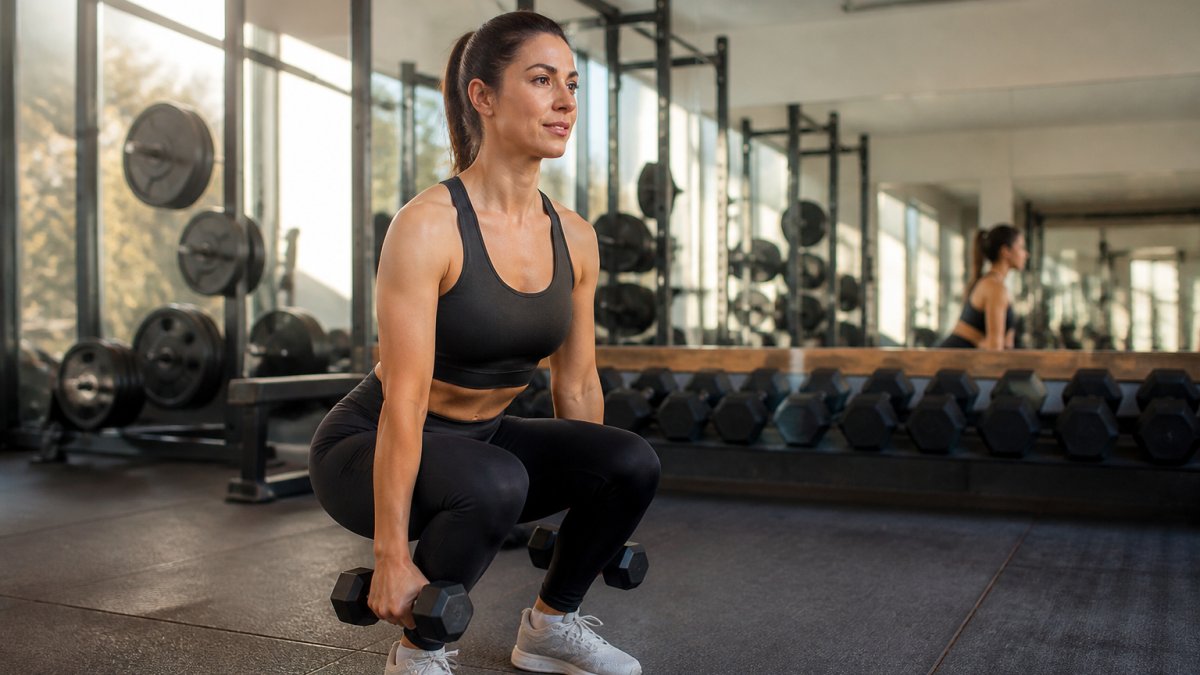
The Six Movements Every Beginner Should Learn
Master these six patterns before anything else:
- Squat (goblet squat with one dumbbell)
- Hinge (Romanian deadlift with dumbbells)
- Push (push-up or chest press)
- Pull (seated row or band row)
- Lunge (bodyweight or holding light dumbbells)
- Core (plank)
These cover every major muscle group. Get comfortable with each one using bodyweight or very light weights first. A useful rule: if you cannot complete the prescribed reps with steady breathing and no wobble, the load is too heavy for that pattern today.
What a Single Session Looks Like
Every full-body session follows the same shape, which makes the first month easy to remember:
- Warm-up (5-8 minutes): marching in place, arm circles, bodyweight squats, and hip hinges with no weight. The goal is warmth and range of motion, not fatigue.
- Main work (25-35 minutes): the six movements in the order listed above, squat, hinge, push, pull, lunge, core. Do the heaviest or most technical pattern first while you are fresh.
- Cooldown (3-5 minutes): slow walking and gentle stretching for the hips, hamstrings, and chest.
Rest 60 to 90 seconds between sets. If you are gasping between sets, rest longer, beginners underestimate how much recovery a set needs.
A Four-Week Plan You Can Follow
Here is a practical first month, scheduled by day. Keep the same six movements all month and change only the volume or the load:
| Week | Monday | Wednesday | Friday |
|---|---|---|---|
| Week 1 | Full body, 2 sets per movement | Rest or walk | Full body, 2 sets per movement |
| Week 2 | Full body, 2 sets per movement | Rest or walk | Full body, 3 sets per movement |
| Week 3 | Full body, 3 sets per movement | Rest or walk | Full body, 3 sets per movement |
| Week 4 | Full body, 3 sets per movement | Rest or walk | Full body, 3 sets, slightly heavier |
Here is how to read that table so you are never guessing mid-session:
- Weeks 1-2 are for learning. Use a load light enough that you could do 3-4 more reps at the end of each set. Your only job is clean reps and remembering the sequence.
- Week 3 adds volume. Add one set to each movement on Friday only. Do not add weight yet.
- Week 4 adds a little load. Keep 3 sets and nudge the weight up on one or two movements, not all six at once.
The golden rule for the whole month: add a set or a little weight each week, never both at once. If a session leaves you wrecked for two days, you added too much.
How Much Weight Should a Beginner Lift?
How much weight should a beginner lift? Start with a load you can move for 10 to 15 reps with good form and two reps still in reserve. That is your starting weight.
Most women begin with 2 to 5 kg dumbbells for upper body and 5 to 10 kg for lower body. Bodyweight is a fine starting point for squats, lunges, and push-ups.
Using Reps in Reserve to Pick Your Load
Reps in reserve (RIR) is the number of clean reps you could still do before failure. Beginners should stop each set with 2 to 3 reps in reserve.
- If you finish 12 reps and could do 5 more, the weight is too light. Add a little.
- If you finish 8 reps and form breaks down, the weight is too heavy. Drop it.
- If you finish 10 to 12 reps with 2 to 3 left, you nailed it.
This method beats guessing. It teaches you to read your own effort instead of chasing a number.
How Many Days a Week Should Beginners Lift Weights?
How many days a week should beginners lift weights? Two to three full-body sessions per week is the sweet spot.
Muscle grows during rest, not during the session. Beginners often make the mistake of training five or six days in week one, then burning out by week three.
A simple rule: leave at least one full rest day between lifting sessions. Walk, stretch, or do light mobility on the days between.
Beginner Dumbbell Workout for Women
A beginner dumbbell workout for women needs only a pair of dumbbells and a small space. Here is a full session you can run at home or in a quiet corner of the gym:
Sports Fitness Gloves for Yoga, Weightlifting & Training →
- Goblet squat: 3 sets of 10 to 12
- Romanian deadlift: 3 sets of 10 to 12
- Dumbbell chest press (on the floor or a bench): 3 sets of 8 to 12
Rest 60 to 90 seconds between sets. Warm up for five minutes first with marching in place, arm circles, and bodyweight squats.
If you train at home and want to add pulling resistance without a cable machine, our Foot Pedal Resistance Band anchors at the foot so both hands stay free for rows and curls. It comes in five colour-coded resistance levels, starting at a light band for beginners.

Learning Proper Form Before You Add Load
Proper form comes before load, every time. A clean rep with a light dumbbell builds more strength than a heavy rep with a rounded back. Spend your first two weeks treating every session as a practice run, the goal is repetition of a good pattern, not exhaustion.
What good form looks like on the main lifts:
- Squat: chest tall, knees track over toes, heels stay down
- Hinge: push hips back, keep a flat back, feel it in the hamstrings
- Push-up: body in one straight line, elbows at roughly 45 degrees
How to Actually Learn a Lift (Not Just Read Cues)
Cues only help if you can feel what they mean. Use this four-step method on each new movement:
- Bodyweight or empty-handed first. Run 8-10 slow reps with no load and watch yourself in a mirror. Slow tempo exposes wobble you would miss at normal speed.
- Add the lightest weight you own. Do one set of 10 and ask: did my form look the same as the bodyweight set? If not, drop back down.
- Film one set from the side. The side angle shows a rounded back, forward knees, or a hip shift that a front mirror hides. Compare it to the cues above.
- Only then add reps or load. If the filmed set looked clean, you have earned the next step.
A common mistake is chasing depth or weight before you can control the movement. Control beats range and range beats load, in that order, for the first month.
Gym Orientation and Equipment Setup for First-Timers
Walking into a gym you have never used is half the battle. A short orientation removes most of the intimidation:
- Book the free intro. Most gyms offer a complimentary orientation or equipment walkthrough for new members. Ask specifically to be shown the dumbbell rack, a bench, and a squat rack.
- Adjust the bench before you load it. Set the back pad so the handles sit at chest height when you lie down. If you have to reach up or down to grab the weight, the pad is wrong.
- Set the rack pins to your height. For a squat rack, the bar should rest just below shoulder level so you can step under it without tiptoeing or crouching.
If you train at home, the same principles apply with less equipment: clear a space wider than your arm span, keep weights within easy reach, and use a sturdy chair for box squats and a floor press instead of a bench.
For grip and hand comfort during pulling and pressing work, a pair of Sports Fitness Gloves protects the palms from calluses and blisters while adding wrist support during lifts.

Exercise Swaps for Injuries or Home Setups
Every movement has a substitute. Use these swaps if something does not feel right:
- Knee discomfort on squats: try box squats to a chair, or reduce depth
- Wrist pain on push-ups: use dumbbells as handles, or do them on an incline
- No dumbbells yet: water bottles, a backpack, or the foot pedal band cover the basics
If pain is sharp, persistent, or comes with numbness, stop and speak to a doctor or physiotherapist before continuing. Form work should feel like practice, not punishment, if a lift consistently hurts rather than works a muscle, that is your signal to swap it, not push through it.
Tracking Progress Beyond the Scale
The scale is a poor scoreboard for strength training. Muscle is denser than fat, so the number can stay flat while your body changes shape. Track these instead:
- Reps and weight: log every set. More reps at the same weight is progress.
- How clothes fit: waistbands and sleeves tell a truer story than a scale.
- Energy and mood: better sleep and steadier energy are real wins.
A simple notebook or a notes app works fine. Write down the weight, reps, and how the set felt. In eight weeks, you will see a pattern no scale can show you.
Conclusion
Starting strength training is a skill, and like any skill it rewards the person who shows up consistently with a plan.
At SheRoar by Black Lion, we build activewear for women who move with intention. Our High Waist Yoga Sports Leggings stay put through squats and lunges, and our Quick-Dry Fitted Yoga Tank keeps you dry through every set.

See the full catalog and dress the woman you are becoming.
Frequently Asked Questions
What is a good starting weightlifting routine for a woman?
Start with three full-body sessions a week built around six movements: a squat, a hip hinge, a push, a pull, a lunge, and a carry. Use light dumbbells or bodyweight only and do two to three sets of 8 to 12 repetitions per exercise. Keep the same routine for four weeks so you can learn the technique and notice the load getting easier before you add weight.
How much weight should a female beginner lift?
Light enough that you could do three or four more reps than planned, but heavy enough that the last two feel like real work. For most women starting out, that means 2 to 5 kg dumbbells for upper-body presses and rows, and 5 to 10 kg for squats and hinges, adjusted to how you feel that day. If your form breaks down, the weight is too heavy, not the exercise.
How many days a week should a beginner woman lift weights?
Two to three days a week is enough to build strength and recover between sessions. A common beginner schedule is Monday, Wednesday, and Friday, with walking or stretching on the days between. Rest days are when muscle repairs itself, so training every day at the start tends to slow progress rather than speed it up.
Can women start weightlifting at home?
Yes. A pair of dumbbells and a resistance band cover most beginner movements, and bodyweight versions of squats, push-ups, and planks work without any equipment. The foot pedal resistance band from SheRoar by Black Lion anchors under your foot so both hands stay free for rows and curls, which makes it a practical substitute for a cable machine at home.