How to Choose Activewear for Different Body Types 2026

Table of Contents
- Start With Measurements, Not Trends
- How to Choose Activewear for Different Body Types: The Core Fit Rules
- Best Sports Bra for All-Day Wear: Matching Support to Your Shape
- High-Waisted Leggings for Different Body Shapes
- Activewear Fabric Technology 2026: What Actually Matters
- How to Style Activewear for Everyday Life
- Inclusive Sizing and Adaptive Activewear: The 2026 Shift
- Frequently Asked Questions
Last Updated: October 1, 2026
Start With Measurements, Not Trends
Knowing how to choose activewear for different body types 2026 starts with a tape measure, not a trend report. The biggest mistake is buying the size you wish you were or a cut that flatters someone else's frame. At SheRoar by Black Lion, the same frustrations come up weekly: leggings that roll down, bras that shift, waistbands that gap.

Measure four points before you buy anything:
- Bust at the fullest point, tape level and snug
- Natural waist, the narrowest part above your navel
- Hip at the widest point of your seat
- Inseam from crotch to ankle bone
Write those numbers down. They matter more than the tag size, since sizing varies widely across brands.
How to Choose Activewear for Different Body Types: The Core Fit Rules
The core fit rules come down to three things: compression level, support level, and range of motion. Get those right and everything else becomes a styling choice, not a fit problem.
Compression is how firmly the fabric holds your body. Light compression suits yoga and walking. Medium compression works for strength training. Firm compression supports high-impact work like running and jumping.
Support level should match the activity, not your cup size alone. A high-impact workout needs a bra that limits vertical bounce. A studio session needs a bra that moves with your breath.
Range of motion is the test most shoppers skip. Raise both arms overhead, twist side to side, squat. If anything digs, rolls, or gaps, the piece is wrong regardless of the size label.
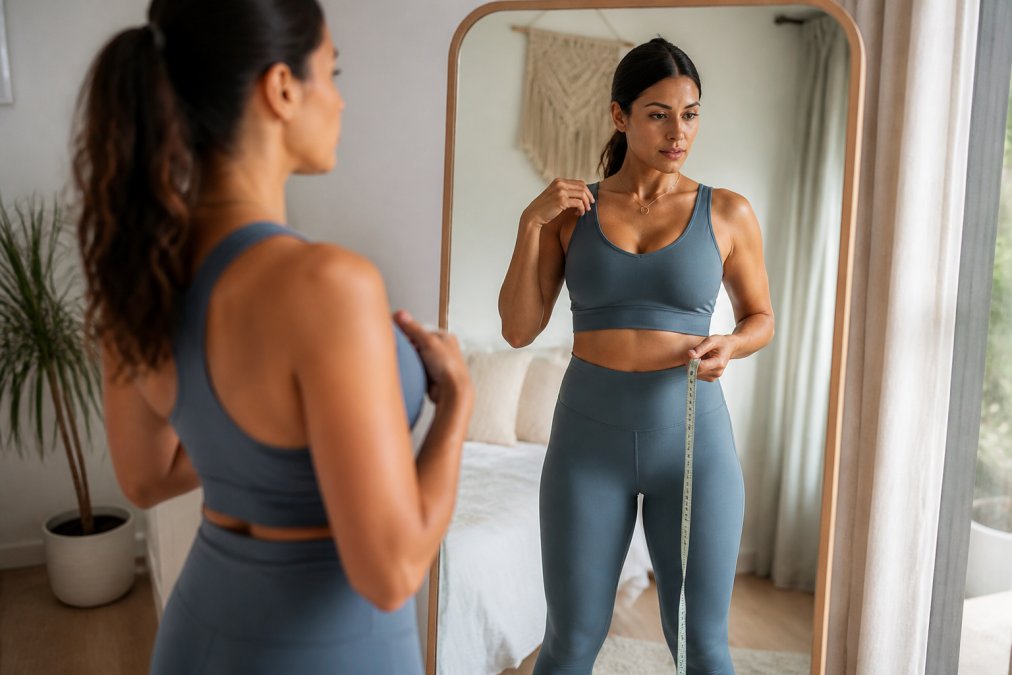
Compression, Support Level, and Range of Motion
Treat these three as a dial you adjust per activity, not a fixed setting.
| Activity | Compression | Support Level | What to Test |
|---|---|---|---|
| Yoga and pilates | Light | Low to medium | Forward folds, overhead reach |
| Strength training | Medium | Medium | Squats, lunges, arm raises |
| Running and HIIT | Firm | High | Jump test, bounce check |
| Everyday wear | Light to medium | Medium | All-day comfort, no digging |
Most women need at least two sets: a light-compression one for studio work and a firmer one for cardio.
Best Sports Bra for All-Day Wear: Matching Support to Your Shape
The best sports bra for all-day wear holds without compressing, breathes under a shirt, and needs no adjusting by lunchtime. The common mistake is choosing support by cup size alone. Match support to both shape and activity, because two women with the same cup size can need very different bras depending on band-to-bust proportion and bounce.
Start with band-to-bust ratio, not the tag letter. A small band with a large cup needs a bra where the band carries the weight and straps are wide and adjustable. A larger band with a smaller cup often does better in a compression-style bra with a wider underband, since a molded cup may gap at the neckline.
Three fit checks matter most:
- The band should stay level when you raise your arms. If it rides up, it is too loose, and the straps are doing work the band should be doing.
- Straps should not dig grooves into your shoulders. If they do, the band is too loose or the cup is too small.
- The gusset and edge seams should lie flat against the skin, with no gaping at the neckline and no spillover at the armpit.
Match support to activity, then adjust for shape:
High-Waisted Seamless Yoga Activewear →
| Activity | Support Level | Shape Adjustment |
|---|---|---|
| Yoga and pilates | Low to medium | Racerback or strappy back for shoulder mobility; avoid molded cups that crease in forward folds |
| Strength training | Medium | Wide, flat underband that stays put during overhead presses; adjustable straps |
| Running and HIIT | High | Encapsulation or hybrid construction; band must lock to ribcage; test with a jump test |
| Everyday wear | Medium | Seamless construction with a soft underband; no underwire pressure points |
For everyday wear, a medium-support seamless bra usually beats a high-impact one, which feels restrictive after the workout.

High-Waisted Leggings for Different Body Shapes
High-waisted leggings for different body shapes work best when rise, waistband construction, and fabric weight match both your proportions and your activity. Most guides stop at body shape, but the same shape needs different leggings for yoga than for HIIT, because fabric and waistband are stressed differently.
Here is the body-type-by-activity matrix that most guides skip:
| Body Shape | Best Rise | Waistband | Yoga/Pilates | Strength Training | Running/HIIT |
|---|---|---|---|---|---|
| Pear (hips wider than bust) | High-rise at natural waist | Wide, contoured, 3+ inches | Mid-rise with side seam detail to balance hip | High-rise with wide band to prevent roll during squats | High-rise with firm compression and squat-proof fabric |
| Hourglass (bust and hips balanced, defined waist) | High-rise at natural waist | Medium width, no dig | High-rise with soft band that follows waist curve | High-rise with contoured seam at waist | High-rise with firm band that locks to waist without squeezing hip |
| Athletic/Rectangular (bust, waist, hips similar) | Mid- to high-rise | Narrow to medium, with seam detail | Mid-rise with curved seam to create shape | High-rise with pocket or seam detail for visual curve | High-rise with compression to define waist |
| Apple (midsection wider than hips) | High-rise above natural waist | Wide, soft, no hard elastic | High-rise with smooth front panel and no front seam | High-rise with wide band that stays above the belly | High-rise with firm compression and high back rise |
Waistband Stability and Squat-Proof Coverage
A band under two inches wide will roll on most bodies during squats; three inches or wider distributes pressure and stays put.
Activewear Fabric Technology 2026: What Actually Matters
Activewear fabric technology 2026 has moved past simple stretch. The labels worth understanding are moisture-wicking, four-way stretch, and seamless construction.
How to Style Activewear for Everyday Life
Styling activewear for everyday life comes down to layering and proportion, so the look reads intentional rather than accidental.
A few approaches that work:
- Layer a cropped vest over a high-waisted legging for a clean, proportional line
- Add an open overshirt or light jacket over a matching set for errands
- Choose one statement piece, like a tie-dye set, and keep everything else neutral
- Swap sneakers for casual shoes to shift a set from workout to weekend
Inclusive Sizing and Adaptive Activewear: The 2026 Shift
Inclusive sizing and adaptive activewear are the biggest shift in the category this year. Brands are widening size ranges, adjusting grading between sizes rather than scaling up, and designing closures and seams for more bodies.
Frequently Asked Questions
How do I work out my body type before buying activewear?
Take four measurements with a soft tape: bust, waist at its narrowest point, hips at their widest, and shoulder width. Compare them to spot the pattern. If bust and hips are close with a clearly narrower waist, you have an hourglass shape. If shoulders, waist, and hips sit within a few centimetres of each other, that reads as an athletic or rectangular build. Wider hips than shoulders points to a pear shape. Write the numbers down and check them against each brand's size guide, because a medium in one label is often a large in another.
What should I look for in the best sports bra for all-day wear?
Look for a wide underband that stays flat when you raise your arms, adjustable straps, and a support level matched to your cup size rather than your shirt size. Seamless construction helps if you are wearing the bra for hours at a time, since there are no edges pressing into the ribs. Try the bra on and reach overhead, twist, and bend forward. If the band rides up or the straps dig in, size down in the band or move to a style with more structure.
Why do my leggings keep falling down during workouts?
Most leggings slide because the waistband is too narrow, the fabric has lost its shape retention, or the rise is too low for your torso length. A high-rise waistband that sits above the hip bone gives the fabric more surface to grip, and a wide flat band resists rolling better than a thin elastic one. Four-way stretch fabric with a decent elastane content holds its shape through squats and forward folds. If leggings that used to stay put now slide, the elastane has likely stretched out and it is time to replace them.
Is premium activewear worth it if I am just starting my fitness journey?
The case for spending more comes down to three things: fabric that keeps its shape after repeated washing, seams that survive stretching, and a fit that does not need adjusting mid-workout. Cheaper gear often loses compression within a few months, which means replacing it more often. If you train three or more times a week, a smaller rotation of well-made pieces usually costs less over a year than constantly replacing worn-out basics. Start with one or two core pieces in neutral colours and build from there.