Are Wire-Free Sports Bras Good for Running? 2026 Review

Table of Contents
- Are Wire-Free Sports Bras Good for Running? The Honest Answer
- Wire-Free vs Underwire: What Actually Changes on a Run
- Compression vs Encapsulation Sports Bra Designs Explained
- How Should a Running Sports Bra Fit? A Practical Fit Test
- Wire-Free Picks Built for High-Impact Sports Bra Support
- When to Replace a Sports Bra (and Signs You've Missed)
- Conclusion: Who Should Run in a Wire-Free Bra
- Frequently Asked Questions
Last Updated: October 12, 2026
Are Wire-Free Sports Bras Good for Running? The Honest Answer
Yes, wire-free sports bras can work well for running, but only when the construction does the job an underwire used to do. A wire-free bra relies on encapsulation, wide bands, and stable straps to control movement, and at SheRoar by Black Lion we build every running bra around that principle. The catch is that not all wire-free bras are engineered for impact.

The honest answer depends on three things: your cup size, your running intensity, and whether the bra holds its shape once you start moving. A wire-free bra with a molded full cup and fixed double straps can handle a 10K. A thin pullover bra with elastic straps cannot, no matter how good it looks on the hanger.
Below, we break down exactly when wire-free works, when it doesn't, and how to test any bra before you commit to a long run.
When Wire-Free Works and When It Doesn't
Wire-free sports bras work best for low to medium-impact activity and for runners who prioritize comfort over maximum lockdown.
Where they struggle is in two scenarios. First, very high-impact running in a bra with no encapsulation, where the fabric stretches and allows vertical movement. Second, long distances in hot conditions, where a poorly ventilated bra traps sweat against the ribcage and causes chafing.
Wire-Free vs Underwire: What Actually Changes on a Run
The difference between wire-free and underwire comes down to where support is generated. An underwire creates a rigid U-shaped frame under the bust, so support comes from the wire itself. A wire-free bra generates support from the fabric, the cup molding, and the band tension instead.
On a run, that changes three things:
- Pressure points. An underwire presses into the ribcage on every stride. A wire-free band spreads that load across a wider area.
- Movement control. Underwire limits downward bounce at the underbust. Wire-free bras must control bounce through cup coverage and strap stability.
- Breathability. Wire-free bras often use seamless, quick-dry fabric, which helps in heat.
The trade-off is real. A wire-free bra that is not built for impact will let the bust move more than an underwire equivalent. That is why construction matters more than the absence of a wire.
Compression vs Encapsulation Sports Bra Designs Explained
Compression and encapsulation are the two ways a sports bra controls movement, and most running bras blend both. Compression flattens the bust against the chest using tight, stretchy fabric. Encapsulation gives each breast its own shaped cup, so movement is contained rather than pressed down.

For running, encapsulation tends to work better at larger cup sizes because it separates and supports rather than squashing.
| Design | How It Controls Movement | Best For | Limitation |
|---|---|---|---|
| Compression | Presses the bust flat against the chest | A-C cups, medium impact | Can feel restrictive, less shaping |
| Encapsulation | Gives each breast a shaped cup | C-F cups, high impact | Needs precise sizing to work |
| Hybrid | Combines shaped cups with firm stretch fabric | Most runners | Fit is less forgiving |
A hybrid design is usually the safest pick for running because it captures the stability of encapsulation and the stretch of compression. If you are unsure which you need, start with the cup size you wear and work outward from there.
How Should a Running Sports Bra Fit? A Practical Fit Test
A running sports bra should fit snugly on the loosest hook setting, with the band sitting level all the way around and no gap between the cup and your chest. You should be able to slide two fingers under the band, but not a whole hand.

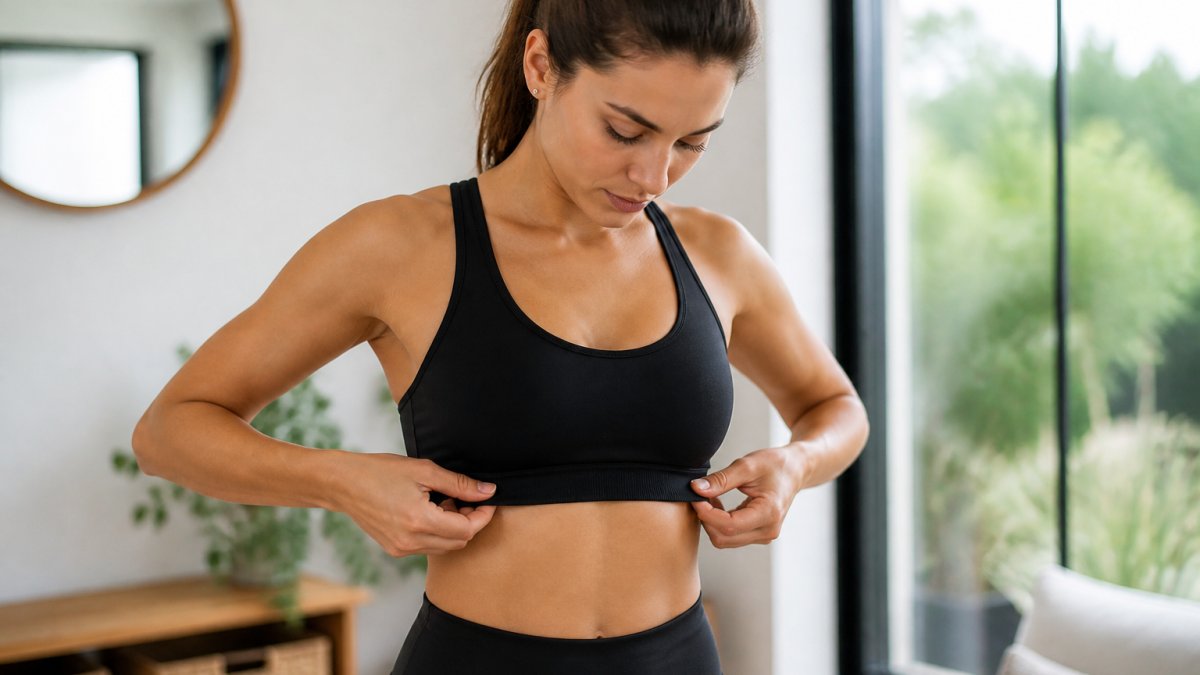
Fit is where most runners go wrong. A bra that feels fine standing still can shift the moment you start moving, so test it in motion, not in the mirror.
The At-Home Bounce and Band Test
Run this test before you commit a bra to a long run:
- Put the bra on the loosest hook and check the band sits level, front and back.
- Raise both arms overhead. If the band rides up, the fit is too loose.
- Jog in place for 30 seconds. Watch for the band sliding or the straps slipping.
- Jump five times. If the bust moves more than a small amount, the cup is not encapsulating enough.
- Check the straps. Adjustable straps should sit flat, not dig into the shoulder.
- Do a short sprint on the spot. If you feel pressure under the ribcage, size up in the band.
Wire-Free Picks Built for High-Impact Sports Bra Support
Not every wire-free bra is built for running, so the useful filter is construction, not marketing. Look for molded or seamed cups, a wide underband, fixed or adjustable double straps, and quick-dry fabric. Below is how to read those features, followed by the SheRoar by Black Lion bras we would reach for on a run.
How to read a support claim
Support claims are usually subjective comfort ratings dressed up as performance data. A more useful way to judge a bra is to ask three questions:
- Does it encapsulate or only compress? Encapsulation contains each breast in a shaped cup; compression presses the bust flat. For running, encapsulation or a hybrid is generally more stable at C cup and above.
- How wide is the underband, and does it stay level? A wide band spreads load across the ribcage and resists rolling. A narrow band concentrates pressure and tends to ride up.
- What do the straps do under load? Fixed double straps and adjustable straps hold position better than thin elastic singles. If the straps stretch, the cup lifts and bounce increases.
A common pattern among runners is that a bra which scores well on subjective comfort still allows noticeable vertical movement at speed.
Wire-Free Shockproof Sports Bra – Full Cup, Quick-Dry, Plus Size →
The picks
The Wire-Free Shockproof Sports Bra - Full Cup, Quick-Dry, Plus Size is our pick for high-impact days. The full cup and shockproof design hold everything in place, and the 92% nylon build is seamless and quick-drying. Fixed double shoulder straps and a side buckle closure keep it locked in. Available in six colors, sizes S to 2XL. Note that it runs one size smaller than US/EU, so size up.
The Women's Front Zipper Yoga and Running Sports Bra suits runners who want easy on-and-off. The front zipper and 3/4 molded cup give structured support, and the shockproof design handles high-impact movement. The soft nylon fabric is stretchy and moisture-wicking, with fixed double straps and sizes S to XL.
For runners who want a bra that doubles as a top, the High-Impact Wire-Free Sports Bra | Push-Up uses removable pads and a push-up construction without hardware. The 87% nylon, 13% spandex blend wicks moisture and dries fast, and the open-back design adds airflow. Sizes S to XXL, suitable for A through F cup.
The Tie-Dye Cross-Back Sports Bra distributes support evenly through its cross-back construction and keeps straps from slipping. The medium-mold full cup has no underwire, and the 80% nylon, 20% spandex blend holds its shape wash after wash. Sizes S to 2XL.
The Women's Wire-Free Shockproof Yoga Sports Bra is built for low to medium impact, with a gathering construction that shapes and lifts without shifting padding. The 90% spandex and Lycra fabric stretches and recovers well. Sizes S to 5XL.
Long-run and hot-weather trade-offs
Even a well-built wire-free bra has limits over distance. Padding can trap heat, seams can soften and rub once sweat saturates the fabric, and elastic can lose some recovery on a very long run.
When to Replace a Sports Bra (and Signs You've Missed)
A sports bra should be replaced every 6 to 12 months of regular wear, or sooner if the band has stretched and the straps no longer hold.
Watch for these signs:
- The band rides up when you raise your arms
- Straps need constant adjusting mid-run
- The cup fabric has lost its shape or the padding shifts
- Seams are fraying or the fabric feels thin
- You are fastening it on the tightest hook just to get support
If any of these sound familiar, the bra is no longer doing its job.
Conclusion: Who Should Run in a Wire-Free Bra
Most runners can run in a wire-free bra, provided it uses encapsulation, a wide band, and stable straps. If you have a larger cup size or run high-impact distances, choose a molded full cup over a thin compression pullover. If you run short distances at lower intensity, a lighter wire-free design will feel more comfortable.
The real test is not the label. It is how the bra behaves when you jog, jump, and sprint in it.
Frequently Asked Questions
Are wire-free sports bras supportive enough for running?
Yes, for many runners. Wire-free sports bras rely on encapsulation, compression, or a mix of both to control bounce instead of a metal wire. A bra with a full cup, fixed or adjustable straps, and a snug band can hold up through running and other high-impact exercise. The deciding factor is your cup size and how the bra fits, not whether it has a wire. Sizing up for a true-to-size fit matters too, since several wire-free styles run small.
Do wire-free sports bras reduce bounce?
They can, when the design is built for it. Wire-free bras reduce bounce through compression (pressing the breasts against the chest) or encapsulation (supporting each breast in its own shaped cup). A full-cup wire-free bra with fixed double straps and a secure closure limits movement during running. A low-impact yoga bra will not control the same bounce. Match the bra's stated support level to your activity, and check the fit before you trust it on a long run.
How should a running sports bra fit?
The band should sit snug and level around your ribcage, not ride up when you lift your arms. Straps should stay put without digging into your shoulders, and the cups should cover fully with no spillage or gaping. You should be able to breathe and twist freely. Test it with a few jumps and a short jog in the fitting room or at home. If the band shifts, the straps slip, or you feel pressure points, size or style is wrong.
How often should you replace a sports bra?
Replace a sports bra when the band loses its stretch, the straps stop holding, or the fabric thins and stops recovering after washing. These signs show up faster with frequent high-impact use and repeated washing. Rotate two or three bras so each one recovers between wears, wash them gently, and retire any bra that no longer passes a fit test.
What is the difference between compression and encapsulation sports bras?
Compression sports bras press the breasts flat against the chest to limit movement. Encapsulation sports bras give each breast its own shaped cup, supporting it individually, which tends to work better for larger cup sizes and high-impact running. Many wire-free bras combine both: a full cup for shaping plus a snug band and fixed straps for hold. The right mix depends on your cup size and how much bounce control you need.
Choosing the right running bra comes down to fit, construction, and how it holds up over time. At SheRoar by Black Lion, we build wire-free sports bras with shockproof support, quick-dry fabric, and molded cups so you can run without adjusting mid-stride. Explore our full-cup, front-zipper, and cross-back designs, then see the catalog to find the fit that works for your runs.