Why Leggings Roll Down at the Waist: Fixes That Work

Table of Contents
- Why Leggings Roll Down at the Waist: The Real Causes
- Sizing Errors: Too Big, Too Small, or Just Right
- Fabric Fatigue, Elastic Breakdown, and Stretch Recovery
- How to Keep Leggings From Falling Down: Step-by-Step Fixes
- Measure Yourself Correctly: The Hip-to-Waist Ratio Method
- Waistband Construction and Seam Design: What Actually Stays Put
- How Body Type and Movement Affect Waistband Slippage
- Best Leggings That Don't Roll Down: What to Look For
- Washing, Drying, and Garment Care to Preserve Elasticity
- Conclusion
- Frequently Asked Questions
Last Updated: September 23, 2026
Why Leggings Roll Down at the Waist: The Real Causes
If your leggings roll down at the waist, the cause is almost always one of three things: wrong fit, worn-out elastic, or a waistband design that can't handle your movement.
Sizing Errors: Too Big, Too Small, or Just Right
A waistband that's too big slides down because nothing holds it in place; one that's too small digs in and rolls over itself.
Watch for these signs:
- Too big: the waistband gapes when you bend forward
- Too small: red marks and a rolled-over band after 10 minutes
- Just right: the band sits flat, stays put, and leaves no deep marks
Fabric Fatigue, Elastic Breakdown, and Stretch Recovery
Elastane and spandex give leggings their snap-back. Over time, that stretch recovery fades, and the waistband stops gripping.
- The band feels looser than when you bought it
- The fabric stays stretched after you take the leggings off
- Small waves or ripples appear along the waistband
How to Keep Leggings From Falling Down: Step-by-Step Fixes
Stop leggings from falling down by fixing the fit first, then the care routine, then the design. Work through these steps in order, each rules out a different cause.
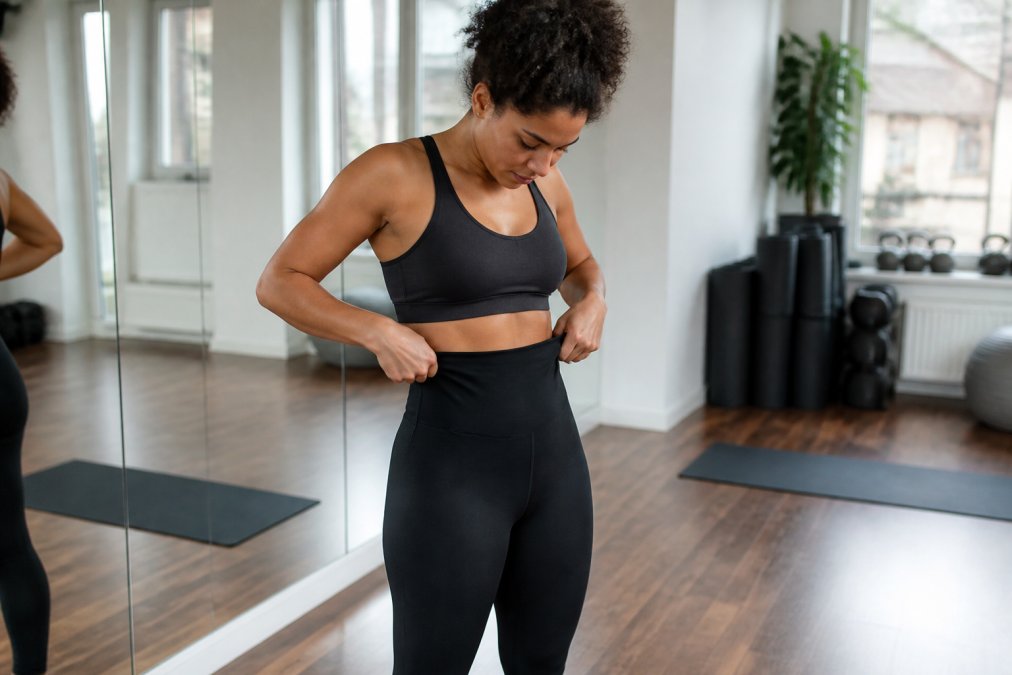
- Check the size using your hip-to-waist ratio. A band that is too big slides because there is nothing to grip; one that is too small digs in and rolls over itself.
- Test the band under movement. Bend forward, squat, and twist in front of a mirror. If the band rolls during a squat, the issue is fit or construction. If it only rolls after 20 minutes of wear, the issue is elastic fatigue.
- Flip the care routine. Cold wash, no dryer, air dry flat. Heat breaks down elastane faster than anything else.
- Try a temporary fix. A few non-destructive adjustments can rescue a pair you already own while you shop for a better one.
- Replace if the elastic is dead. If the band stays stretched after you take the leggings off, no fix will bring it back.
DIY Temporary Fixes That Don't Damage Your Leggings
A few non-destructive tricks keep a slipping waistband in place while you shop for a better pair.
- Fold the band once. A single fold adds grip without cutting off circulation. This works best on wide bands (5 cm or more) because a thin band will just roll again.
- Tuck the band under a fitted top. This stops the roll from traveling up your waist but does not fix the underlying grip problem.
- Add silicone grip strips. Sew-in or stick-on strips add friction at the waistline. Use strips designed for garment use, not household silicone tape, which can leave residue.
- Tighten a drawstring. If your leggings have one, cinch it before your workout. It is the single most effective built-in fix because you can adjust tension as the fabric relaxes.
- Layer with high-rise underwear. The extra grip at the waistline helps hold the band flat, especially on curvier shapes where the band has more distance to travel.
- Use fabric tape for an emergency fix. A small strip of double-sided fabric tape at the back waistband can hold a band in place for a single workout, not permanent, but useful when you are away from home.
Why some fabrics resist roll-down better than others
Material matters as much as fit. Leggings come in two main fabric families that behave differently at the waistband.
- Compression fabrics use a higher elastane content (often 20-30%) and hold their shape under tension, resisting roll-down because the fabric itself has more snap-back. The trade-off: they can feel tighter and less breathable.
- Standard spandex blends use a lower elastane content (often 10-20%) and rely more on cut and band construction for grip. They feel softer but lose stretch recovery faster, especially with heat exposure.
Match the fix to your movement
- Running: repeated hip flexion pushes the band up and over. A high-rise band with a drawstring is the most reliable fix.
- Yoga: deep forward folds and twists test the band's grip. A wide seamless band with silicone lining works best because it conforms without digging.
- Lifting: squats and deadlifts stretch the fabric at the hip. Compression fabric with a wide band holds better than a soft blend.
- Everyday wear: sitting and standing slowly loosens the band over hours. A mid-rise band with a drawstring lets you re-tighten as needed.
These fixes buy time but do not repair worn-out elastic, so treat them as a bridge, not a solution. If the right band type for your ratio and activity still rolls, the elastic is likely fatigued, replace the pair.
Measure Yourself Correctly: The Hip-to-Waist Ratio Method
Most sizing guides tell you to measure your waist and hips, then match a chart. That works only if your body matches the brand's fit model. The hip-to-waist ratio method goes further: it tells you which waistband construction will actually stay up on your shape, not just which size to order.
Step 1: Measure your natural waist
Use a soft tape at your natural waist, the narrowest point of your torso, usually just above the belly button. Keep the tape snug but not tight. Write the number down.
Step 2: Measure your fullest hip
Wrap the tape around the fullest part of your hips and seat, usually 7-9 inches below your natural waist, parallel to the floor. Write the number down.
Step 3: Divide waist by hip
Divide your waist measurement by your hip measurement. For example, a 28-inch waist and 40-inch hip gives a ratio of 0.70. A 32-inch waist and 38-inch hip gives 0.84.
Step 4: Match your ratio to a waistband type
This is the step most guides skip. Your ratio predicts how much grip the band needs and where it will fail.
- Ratio below 0.75 (curvier hip-to-waist difference): You have more distance between waist and hip, so a straight-cut band has less to hold onto. Look for a wide high-rise band (at least 5 cm), a drawstring, or a silicone grip lining. Avoid low-rise or thin single-stitch bands, they will roll down within minutes of movement.
- Ratio 0.75-0.85 (average difference): Most standard leggings are cut for this range. A wide mid-rise or high-rise band with flatlock seams will usually hold. If you still get roll-down, size down one or switch to a band with a grip element.
- Ratio above 0.85 (straighter hip-to-waist difference): Your waist and hip are closer in size, so the band may gape at the back rather than roll at the front. Look for a band with a drawstring or a higher elastane content so it can cinch without digging. A seamless band can also help because it conforms rather than gaps.
Why this matters more than the size chart
Once you know your ratio, you can predict whether any brand's cut will hold, before you buy.
Hip-Lifting Tummy Control Leggings →
Waistband Construction and Seam Design: What Actually Stays Put
Waistband design decides whether leggings stay up better than any other feature. A wide, high-rise band with solid seam construction holds flat. A thin, single-stitch band rolls.
Look for these construction details:
- Wide band: at least 5 cm for real tummy control and grip
- High-rise or mid-rise cut: sits above the hip bone for less slippage
- Flatlock seams: lie flat against the skin and resist friction
- Silicone grip lining: adds friction at the waistline
- Drawstring option: lets you adjust the fit as fabric relaxes
How Body Type and Movement Affect Waistband Slippage
Your body type and the way you move change how a waistband behaves. A band that holds on one body can roll on another, even in the same size.
Movement type matters too:
- Running: repeated hip flexion pushes the band up and over
- Yoga: deep forward folds and twists test the band's grip
- Lifting: squats and deadlifts stretch the fabric at the hip
- Everyday wear: sitting and standing slowly loosens the band
Best Leggings That Don't Roll Down: What to Look For
The best leggings that don't roll down share a few features: a wide high-rise band, solid stretch recovery, and a cut that matches your shape. Skip anything with a thin band or worn elastic.
Use this checklist before you buy:
- Wide high-rise or mid-rise band (5 cm or more)
- Four-way stretch with nylon or elastane blend
- Flatlock or seamless construction
- Drawstring or silicone grip at the waistline
- Size chart that lists hip and waist measurements
| Feature | Why It Matters | What to Avoid |
|---|---|---|
| Band width | Wider bands grip and stay flat | Bands under 5 cm |
| Rise | High-rise sits above the hip bone | Low-rise cuts |
| Fabric blend | Nylon and elastane hold shape | Thin cotton blends |
| Seam type | Flatlock lies flat, resists friction | Single-stitch bands |
| Grip element | Drawstring or silicone adds hold | No grip at all |
Washing, Drying, and Garment Care to Preserve Elasticity
Cold water and air drying are the two habits that keep elastic alive longest. Heat kills stretch recovery, so treat your leggings like delicates, not towels.
Follow these care rules:
- Wash cold. Use a gentle cycle at 30°C or lower.
- Skip the dryer. Tumble drying breaks down elastane fast. Air dry flat instead.
- Turn them inside out. This protects the outer fabric from friction.
- Use mild detergent. Harsh chemicals wear down synthetic fibers.
- Wash less often. Every second or third wear is plenty for most leggings.
Conclusion
A rolling waistband is a fit, fabric, or design problem, and each has a clear fix. Measure with the hip-to-waist ratio method, check the band construction, and care for the elastic so it lasts.
Frequently Asked Questions
Do my leggings slide down because they're too big or too small?
Both cause slippage, but for different reasons. If they're too big, the waistband can't grip your body and gravity pulls it down. If they're too small, the fabric stretches past its limit and loses stretch recovery, so it creeps down during movement. Check your hip-to-waist ratio against the brand's sizing guide. If the waistband leaves red marks or you're constantly tugging, size up. If it gapes at the back, size down.
What features should I look for in leggings to prevent rolling?
Look for a wide high-rise waistband that sits flat without folding, four-way stretch fabric with good stretch recovery, and seam construction that follows your body's lines. A drawstring or silicone grip inside the waistband adds extra hold. Moisture-wicking nylon-blend or polyester-elastane fabrics resist fabric fatigue better than thin cotton blends. SheRoar's Hip-Lifting Tummy Control Leggings use a wide tummy control band and nylon-blend four-way stretch built to stay flat through squats and forward bends.
Can high-waisted leggings roll down if they are the wrong size?
Yes. High-rise leggings roll down when the waistband is too loose to grip or too tight and stretched beyond its elastic limit. A high waistband only prevents rolling if it matches your hip-to-waist ratio and the fabric can recover its shape. Measure your natural waist and fullest hip, compare both to the sizing guide, and size up if you're between sizes. The wrong fit defeats the purpose of a high-rise design.
Does fabric composition affect whether leggings roll down?
Fabric composition matters more than most people realize. Synthetic fibers like spandex (elastane) and nylon provide stretch and recovery, while cotton loses shape faster. A blend with at least 20% elastane holds its compression through repeated wear and wash cycles. Fabric fatigue sets in when elastic fibers break down from heat, friction, and tumble drying. Wash in cold water and air dry to extend the life of the waistband and prevent rolling.