Encapsulation vs Compression Sports Bras: 2026 Guide

Table of Contents
- Encapsulation vs Compression Sports Bras: How the Two Designs Differ
- Compression vs Encapsulation: A Side-by-Side Comparison
- How to Find Your Perfect Bra Size Before You Choose a Design
- Sports Bra Support Levels and Which One You Actually Need
- The Best Sports Bra for Running: What to Look For
- Choosing a Sports Bra for Large Breasts
- Conclusion
- Frequently Asked Questions
Last Updated: October 13, 2026
Encapsulation vs Compression Sports Bras: How the Two Designs Differ
Most sports bras sit between the two, molded cups plus a firm underband makes a hybrid, and that middle ground is where much of the confusion starts.
The practical difference: compression holds you still by pressing you flat, while encapsulation cradles each breast in its own space.
Neither design is better. Each fails differently, and knowing which failure you can live with matters more than any spec sheet.
Compression vs Encapsulation: A Side-by-Side Comparison
The two designs differ most in how they distribute force. Compression spreads load across the whole chest wall, so it feels secure but flattening.
| Feature | Compression | Encapsulation |
|---|---|---|
| Construction | Single stretch panel | Separate cup panels |
| Bounce control | Flattens the bust | Cradles each breast |
| Shape | Minimized | Natural, defined |
| Common issue | Uniboob, pressure | Seam rub, wire pressure |
| Best for | Smaller cups, low to medium impact | Larger cups, high impact |
| Wire-free option | Yes, easily | Yes, with molded cups |
Compression wins on simplicity: fewer seams means fewer places to chafe, and a single panel is easy to size. Encapsulation wins on support per unit of squeeze.
What most guides miss is that the failure mode matters more than the category: a too-loose compression bra does nothing, and an encapsulation bra with a mispositioned wire hurts before it helps.
How to Find Your Perfect Bra Size Before You Choose a Design
Getting the size right matters more than picking a design: a well-sized compression bra outperforms a badly sized encapsulation bra every time, so measure before you shop.
Measure your underband snugly around the ribcage, directly under the bust, then measure your bust at the fullest point and subtract the band to get your cup size.
Three fit checks catch most problems:
- The band should sit level all the way around, not ride up at the back.
- The center front should lie flat against your sternum, not float away.
- Straps should hold without digging grooves into your shoulders.
If the band climbs when you raise your arms, or you can slide two fingers under it easily, it is too loose.
The At-Home Running Test
A five-minute run in your living room tells you more than a mirror does. Put the bra on, jog in place for 60 seconds, then do 10 jumping jacks.
If the band moves, size down. If the cup gaps at the top, the cup is too large or the shape is wrong for you. If a seam rubs during 60 seconds of jogging, it will rub raw at kilometre five.
Sports Bra Support Levels and Which One You Actually Need
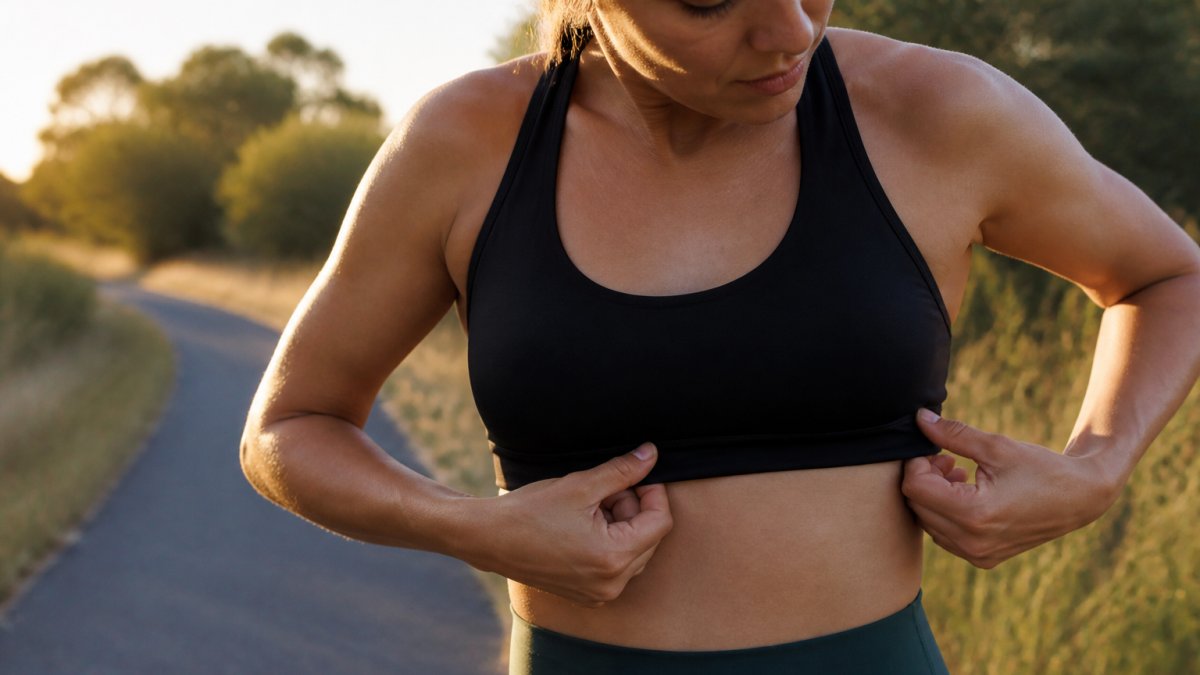
Support levels map to impact, not cup size alone: low-impact suits yoga and walking, medium-impact suits cycling and light training, and high-impact suits running, HIIT, and jumping.
The mistake is buying one bra for everything.
Our advice: match the bra to your hardest regular activity, then size down for everything easier. If you run twice a week, buy for running.
For high-impact days, our Women's High-Intensity Seamless Shockproof Sports Bra is built with seamless construction to cut chafing and shockproof support for running and jumping. For lower-impact sessions, the Women's Wire-Free Shockproof Yoga Sports Bra keeps the ribcage free of wire pressure through seated and floor work.


The Best Sports Bra for Running: What to Look For
The best sports bra for running stops vertical bounce without restricting your breathing. Running loads the bust hardest, so design choices show up here first.
Look for these in order:
- A firm, wide underband that sits level on the ribcage
- Adjustable straps or fixed double straps that do not stretch out
- Moisture-wicking fabric that dries fast in heat
Bounce control is the whole point. A bra that holds you still on the first kilometre but sags by the fifth has a recovery problem, not a support problem. Fabric that loses its stretch will not hold shape after repeated washing.
Do Wire-Free Bras Actually Work for Running?
Yes, with conditions. A wire-free bra works for running if it has a firm, wide underband, a cup structure that separates or cradles each breast, and fabric that recovers its shape.
The honest answer is that wire-free running bras work best in three situations:
- Smaller cups (roughly A to C) at any running pace. A well-fitted compression or hybrid wire-free bra can hold the bust still without a wire, because there is less mass to control.
- Larger cups at easy to moderate pace, in a hybrid or encapsulation-style wire-free bra. Separate cup panels or molded inserts do the work a wire would normally do, distributing weight instead of pressing it flat.
- Any cup size on shorter runs where chafing risk is low. The longer the run, the more a wire-free bra's weaknesses, band creep, seam rub, fabric fatigue, start to show.
Where wire-free bras struggle is high-impact running in larger cup sizes over long distances. That is not a design flaw so much as a physics problem: without a wire or rigid cup edge, the bra depends entirely on band tension and fabric recovery to control a heavier bust.
What Support Claims and Bounce Measurements Actually Mean
Most brands describe support in words, "high impact," "maximum control," "shockproof", rather than numbers, so it helps to know what the measurable terms mean.
Women's Wire-Free Shockproof Yoga Sports Bra →
Independent testing commonly shows encapsulation and hybrid designs reduce vertical movement more than pure compression in larger cup sizes, while compression performs comparably in smaller cups.
Treat any support claim as a starting point, not a guarantee.
A Practical At-Home Running Test
A five-minute run in your living room tells you more than a mirror does. Put the bra on, jog in place for 60 seconds, then do 10 jumping jacks.
If the band moves, size down. If the cup gaps at the top, the cup is too large or the shape is wrong for you.
For a more realistic test, run one easy kilometre outdoors in the bra before committing to a long run.
The Wire-Free Shockproof Sports Bra uses fixed double shoulder straps and a side buckle closure to stay locked in during running, with a hollow cut-out at the back for ventilation.

Choosing a Sports Bra for Large Breasts
A sports bra for large breasts needs encapsulation, or a hybrid that borrows from it. Compression alone cannot hold a heavier bust still without squeezing hard enough to restrict breathing.
This is the clearest dividing line in the whole comparison. Below roughly a C cup, compression does the job and stays comfortable. Above that, separate cup support starts to matter, because it distributes weight instead of pressing it flat.
How Support Needs Change by Cup Size
The C-cup cutoff is a useful rule of thumb, not a hard line. As cup size increases, what changes is not just how much support you need but what kind works.
- A to B cups: Compression or light hybrid designs usually control bounce well. The priority is a firm band and fabric that recovers, not cup structure.
- C to D cups: Hybrid designs start to outperform pure compression. Molded cups or gathering panels add shape and reduce movement without a wire.
- DD and above: Encapsulation or a strong hybrid becomes the practical choice. Separate cup support distributes weight across the ribcage and back, which reduces both bounce and shoulder strain.
How Breast Shape Affects the Choice
Cup size is only half the picture. Breast shape, fullness on top versus bottom, natural projection, and space between the breasts, changes which designs fit well.
- Full on top: Look for cups with enough coverage at the upper edge. A cup that cuts across the top will spill during running.
- Full on bottom: Look for a bra with a firm lower cup and a band that sits level. If the band rides up, the lower cup cannot do its job.
- Shallow or wide-set: Compression can work better than expected, because the bust sits closer to the chest wall and there is less mass to control.
How Running Intensity Changes the Equation
The same bra that works for a 5K may not work for a half marathon. Intensity and duration both raise the demand on the bra.
- Easy runs and walk-run intervals: A well-fitted hybrid wire-free bra is often enough, even in larger cups.
- Tempo runs and hill repeats: Bounce increases with pace. This is where encapsulation or a strong hybrid earns its place.
- Long runs: Chafing, sweat, and fabric fatigue matter as much as bounce control. Flat seams, moisture-wicking fabric, and a band that does not creep become the deciding factors.
What to prioritise:
- Full cup coverage with a molded insert for shape without a wire
- A wide underband that carries weight on the ribcage, not the shoulders
- Fixed or adjustable straps that spread load across the back
The Wire-Free Shockproof Sports Bra - Full Cup pairs a full cup and thin molded insert with a wire-free build, which gives shaped support without a steel ring pressing the ribs. The Women's Quick-Dry Gathering Shockproof Sports Bra adds a gathering design that lifts and shapes without extra padding, in sizes S to 5XL.
A common mistake is sizing up to escape pressure. That trades a tight band for a loose one, and a loose band bounces. Fix the band first, then adjust the cup.
Conclusion
The real challenge is not picking a side in the encapsulation vs compression debate. It is finding a bra whose band, cup, and fabric hold up on your hardest training day, not just in the fitting room.
At SheRoar by Black Lion, we build wire-free sports bras around shockproof support, gathering construction, and quick-dry fabric that keeps its shape through repeated washing.
See our catalog and find the support level that matches how you actually move.
Frequently Asked Questions
What is the difference between encapsulation and compression sports bras?
Compression bras press the breasts flat against the chest wall with one continuous panel of stretch fabric, which limits vertical bounce. Encapsulation bras give each breast its own molded cup, so the support comes from shaping rather than flattening. Many bras sold today combine both: separate cups for shape plus a compressive outer layer for movement control. The design you pick depends on your cup size and how much impact your workouts involve.
Are compression sports bras good for running?
They can be, particularly for smaller cup sizes and shorter runs. Compression holds movement close to the body, which limits bounce, and the single-panel construction keeps the bra light and breathable. For larger cup sizes or long-distance running, a design with separate cups or a wire-free shockproof build tends to hold position better over time. Whichever you choose, test it with a short run before committing to a long one.
Do encapsulation sports bras provide more support?
Encapsulation generally gives more shaped support because each breast is held in its own cup rather than pressed flat. That matters most at larger cup sizes, where compression alone can leave the breasts moving together and pulling on the shoulders. Support also depends on band fit, strap adjustment, and cup coverage, so a well-fitted compression bra can outperform a poorly fitted encapsulation one.
Which sports bra is best for larger breasts?
Look for a bra with full cup coverage, a firm band that stays level at the back, and wide adjustable straps that spread weight across the shoulders. A wire-free full cup design with shockproof construction, such as the Wire-Free Shockproof Sports Bra in Full Cup, keeps everything in place through runs and gym sessions without a wire pressing into the ribcage. Check the size note before ordering, since some styles run small.
How should a sports bra fit for high-impact exercise?
The band should sit level and snug, staying in place when you raise your arms. Straps should be adjustable and not dig in, and the cups should cover the full breast without gaping or spilling. Test it by jumping in place for 30 seconds: if you need to adjust the band or straps afterward, size down or try a different design. A bra that needs constant tugging will not hold up over a long run.