Best Leggings That Stay Up During Workouts (2026 Guide)

Table of Contents
- Why Leggings Slide Down, Roll and Ride Up Mid-Workout
- Quick Comparison: Best Leggings That Stay Up During Workouts
- 1. Women's High-Waist Cycling and Yoga Leggings: Best Overall for Waistband Stability
- 2. Women's Non-Slip Athletic Running Pants: Best for High-Impact Cardio and Extended Sizing
- 3. Women's High-Waist Running Fitness Leggings: Best Lightweight Pick for Distance Running
- 4. High-Waist Compression Leggings with Pockets: Best for Lifters Who Carry a Phone
- 5. Women's High Waist Squat-Proof Performance Leggings: Best for Deep Squats and Studio Lighting
- 6. Seamless High-Waist Sports Pants: Best for Pilates and Seam-Sensitive Skin
- How to Keep Leggings From Rolling Down
- How to Choose the Right Size Workout Leggings
- Frequently Asked Questions
Last Updated: September 10, 2026
Why Leggings Slide Down, Roll and Ride Up Mid-Workout
The best leggings that stay up during workouts solve one problem: they hold their position while you move. Most fail because the waistband loses tension, the fabric stretches out, or the fit was never right for your body.
Leggings that stay up are high-waist bottoms engineered with compression waistbands, four-way stretch fabric, and a gusset that prevents riding. The waistband is where most pairs fail: a band that sits flat without digging or folding holds; one that rolls does not.
Three forces work against your waistband every time you move.
The Three Forces Behind Waistband Failure
Gravity pulls the legging down with every step and jump. Friction from thigh movement drags fabric upward at the crotch, which is why leggings ride up during running even when the waist stays put. And body heat softens elastic over time, so a band that felt secure on day one loosens after repeated washes.
A common mistake is sizing down to stop the slide. That tightens the band against the stomach but increases roll-down because the fabric has nowhere to go when you bend. The fix is a wide, flat compression band with shape-recovering fabric.
Why Body Type Changes the Fix
Waist-to-hip ratio decides which waistband design works on you. Women with a straighter torso often find narrow elastic bands slide because there is no natural curve to anchor them. A wide tummy-control band distributes pressure across a larger surface and grips better (peer-reviewed research). Women with a pronounced hip-to-waist difference get more hold from a high-rise band that sits above the widest point of the hip.
The rise matters as much as the band. High-waisted leggings for squats stay anchored because the band rests on the narrowest part of the waist, above the hip bone. Mid-rise sits where the body bends, exactly where roll-down starts.
Quick Comparison: Best Leggings That Stay Up During Workouts
| Legging | Price | Best For | Waistband Type |
|---|---|---|---|
| High-Waist Cycling and Yoga Leggings | $29.95 | Best overall stability | High-rise compressive band |
| Non-Slip Athletic Running Pants | $47.71 | High-impact cardio, extended sizing | Non-slip waistband |
| High-Waist Running Fitness Leggings | $40.95 | Distance running | High-elastic waistband |
| Compression Leggings with Pockets | $52.99 | Lifters carrying a phone | High-waist elastic band |
| Squat-Proof Performance Leggings | $49.99 | Deep squats, studio lighting | High-waist tummy control band |
| Seamless High-Waist Sports Pants | $52.95 | Pilates, seam-sensitive skin | Seamless high-waist knit |
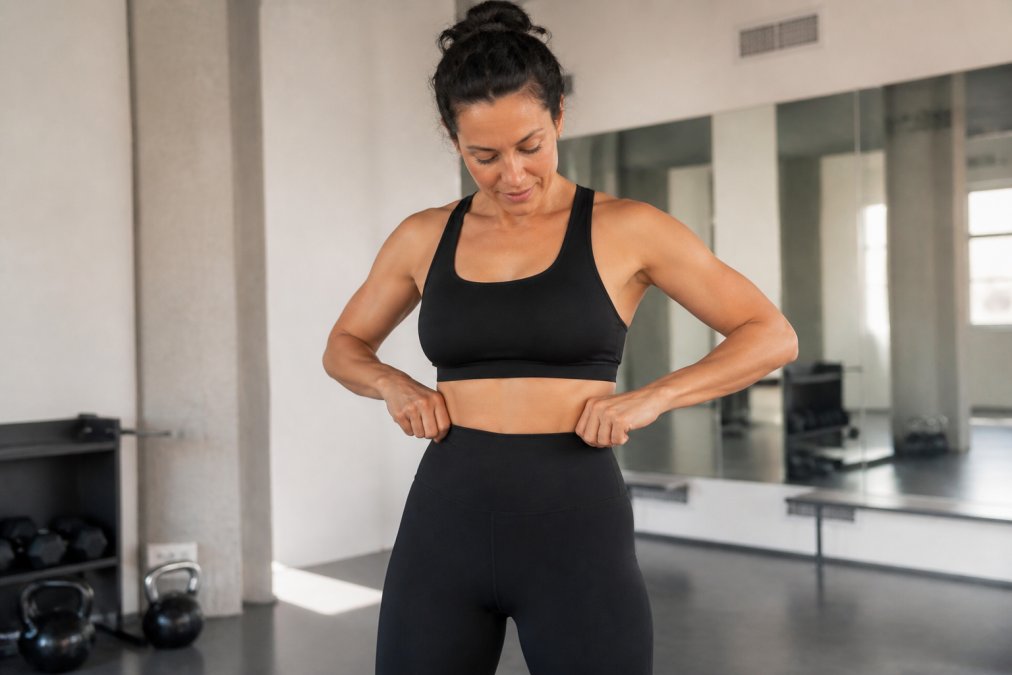
Every pair below was selected for waistband stability first, then fabric recovery, then movement pattern.

1. Women's High-Waist Cycling and Yoga Leggings: Best Overall for Waistband Stability
The Women's High-Waist Cycling and Yoga Leggings take the top spot because the waistband stays flat against the torso with no digging and no rolling through a full session. The high-rise compressive band holds its shape through cycling, yoga, or HIIT, and four-way stretch moves with the body so deep squats and wide-leg poses do not pull it out of position.
Pros: Compressive high-rise band that resists rolling; four-way stretch for full range of motion; moisture-wicking; available in Black and Grey, sizes S to XL. Cons: Runs one size smaller than US sizing, so size up for a true fit; limited to two colors.
2. Women's Non-Slip Athletic Running Pants: Best for High-Impact Cardio and Extended Sizing
Cardio tests waistbands hardest, and the Women's Non-Slip Athletic Running Pants are built around a non-slip waistband that locks in place during high-movement work. The nylon and spandex blend delivers stretch and shape retention rep after rep, and these are also the pick for extended sizing: XXL, 3XL, and 4XL without compromising the performance fabric.

Pros: Non-slip waistband for jumping and sprinting; shape retention across repeated wear; extended sizing to 4XL; Black and Navy Blue. Cons: Runs a size small; the non-slip band feels firmer than a standard elastic waist on first wear.
3. Women's High-Waist Running Fitness Leggings: Best Lightweight Pick for Distance Running
Mile two is where cheap leggings bag at the knee. The Women's High-Waist Running Fitness Leggings hold their position through a 5K without the waistband rolling down or the fabric losing shape. The high-elastic waistband resists folding during sustained running, and the second-skin fit cuts wind resistance without restricting circulation. Lightweight, breathable fabric stops heat buildup on warm-weather runs.

Pros: High-elastic band that resists sliding over distance; true to size; four color options; breathable for outdoor running. Cons: Not built for heavy lifting; second-skin fit leaves little room for layering.
4. High-Waist Compression Leggings with Pockets: Best for Lifters Who Carry a Phone
If you train with a phone, keys, or a card, the pocket is the deciding feature. The High-Waist Compression Leggings with Pockets use welt side pockets deep enough for a phone and secure enough to forget about mid-set. The 220gsm nylon-spandex knit compresses without restricting, and the high-waist elastic band sits flat with no rolling or digging. Contrast side stitching gives a structured look that works outside the gym.
Pros: Functional welt pockets; 220gsm compression knit; squat-proof and opaque; true to size. Cons: Available in Black only; the heaviest fabric on this list, so it runs warm.
5. Women's High Waist Squat-Proof Performance Leggings: Best for Deep Squats and Studio Lighting
Opacity under studio lights is the test most leggings fail. The Women's High Waist Squat-Proof Performance Leggings hold their opacity at the bottom of a squat without thinning, and the high-waist tummy-control band stays flat without folding during core work. Four-way stretch delivers full range of motion from overhead press to deep squat without pulling.
Pros: Squat-proof at full depth; wide tummy-control band; four-way stretch; true to size. Cons: Single color option in Blue; sizing tops out at XL.
6. Seamless High-Waist Sports Pants: Best for Pilates and Seam-Sensitive Skin
Seam friction is the quiet problem in floor work. The Seamless High-Waist Sports Pants use a seamless knit construction that eliminates seam friction along the inner thigh and waistband, so there is no chafing and no bunching mid-rep. The nylon-spandex blend stretches in every direction and snaps back without sagging, and the high-waist silhouette sits above the hip and stays there between sets.
Pros: Seamless knit for zero chafe; high-waist band that resists rolling; five colors; sizes to XXL. Cons: Runs one size smaller than US/EU sizing; the seamless knit offers less compression than the squat-proof pairs.
How to Keep Leggings From Rolling Down
Roll-down is not one problem, it is three different problems wearing the same name, and the fix depends on which movement pulls your waistband out of place.
Activity-Specific Slippage: What Actually Causes the Roll
Different movements load the waistband in different directions:
- Running and jogging: Repeated hip flexion and extension creates a piston-like motion: each stride pushes the waistband up at the front while gravity pulls it down at the back, so the band migrates over a few miles. The fix is a high-elastic band with enough vertical height to resist that load, narrow bands lose this fight.
- Burpees, jump squats, and plyometrics: These combine deep hip flexion with a vertical jump, compressing the fabric at the waist at the bottom and releasing it at the top. A band that does not recover quickly folds over itself within a few reps. Look for four-way stretch with high spandex content and a flat-lock seam.
- Heavy squats and deadlifts: The belt-like pressure of a loaded barbell can push a waistband down, especially if it sits at the natural bend point of the waist. A high-rise band above the hip bone, on the narrowest part of the torso, has less room to travel, which is why lifters often prefer a tummy-control band.
- Yoga and Pilates: Floor work involves sustained hip flexion and spinal twisting. A band that sits flat without digging holds better here than a compressive band that creates pressure points on your back. Seamless construction also matters because seams catch and bunch during twists.
The Three Habits That Actually Extend Waistband Life
Beyond matching the band to the movement, three habits extend waistband life:
- Size by your hip measurement, not your usual dress size. A band that is too small rolls because the fabric has nowhere to go when you bend. One that is too large slides because there is no tension to grip. Your hip measurement is the anchor point for high-waist leggings.
- Skip fabric softener. Softener coats the spandex fibers and reduces both moisture-wicking performance and elastic recovery, so the band loses its snap (PubMed). Leggings often feel looser after a few months of softener use even if the fabric is intact.
- Wash cold and air dry. Heat is the enemy of spandex. Hot water and dryer cycles break down the elastic fibers that do the holding. Cold wash and air dry preserve the band's recovery for far longer.
When to Replace, Not Repair
Even the best leggings have a lifespan. If a waistband that used to stay put now rolls within the first ten minutes of a workout, the spandex has likely fatigued, and no washing trick or sizing adjustment will bring it back. This is normal after 6-12 months of heavy use (peer-reviewed research). Rotate two or three pairs rather than wearing one every session, this gives the elastic time to recover.
How to Choose the Right Size Workout Leggings
Most sizing guides tell you to measure your waist and hips and compare to a chart. That is necessary but not sufficient. Two women with identical measurements can have completely different experiences with the same pair because of biomechanics, specifically, how your waist-to-hip ratio affects where the waistband travels during movement.
Body-Type Biomechanics: Why Your Shape Changes the Fix
A waistband stays in place when it can anchor against a part of your torso that does not change shape dramatically during movement. The narrowest part of your waist, usually just above the hip bone, is the most stable anchor point, and how much your body curves between that point and your hips determines how much the band slides.
How different body types typically experience slippage:
- Straight or athletic torso (waist-to-hip difference under 8 cm): There is less natural curve for the band to catch on, so narrow elastic bands slide. A wide tummy-control band distributes pressure across a larger area and grips better, look for bands at least 3-4 inches wide.
- Moderate curve (waist-to-hip difference 8-20 cm): This is the range most high-rise compression bands are designed for. The band anchors above the widest point of the hip, and the natural curve helps hold it.
- Pronounced curve (waist-to-hip difference over 20 cm): The band has a longer distance to travel over the hip curve, so it is more likely to roll or slide. A high-rise band with a non-slip grip strip or drawstring adds security, and it needs to sit above the widest part of the hip.
The Rise Matters as Much as the Band
High-waisted leggings stay anchored because the band rests on the narrowest part of the waist, above the hip bone. Mid-rise sits where the body bends, exactly where roll-down starts. With a pronounced curve, mid-rise is almost guaranteed to roll during squats or running; with a straighter torso, a high-rise band with a wider profile gives you the surface area to hold.
A Fit-Testing Protocol That Works
Before you commit to a pair, try this sequence with the tags on:
- Squat to full depth. Stand up and check whether the band moved. If it rolled or slid, size up or switch to a wider band.
- Do ten jumping jacks. This tests vertical loading. The band should stay flat without folding.
- Bend forward at the waist. This tests whether the band has enough tension to stay against your torso when your body changes shape.
- Check the gusset. A well-designed gusset prevents pulling at the crotch during movement. If a wedgie forms during the squat test, the rise or gusset shape is wrong for your body.
A pair that passes all four tests on day one will hold through the movements you actually train. If it fails any, no amount of washing or adjusting will fix it, the fit is wrong for your body.
The single most useful measurement for legging fit is not your waist or your hip, it is the difference between them. That number tells you which waistband design will actually stay put on your body.
Frequently Asked Questions
Why do my workout leggings keep falling down?
Most leggings fall down because the waistband fabric has too much stretch and too little elastic recovery, so it loses its grip once you start moving. A second cause is sizing: if the gusset pulls or the fabric bunches at the knee, the legging is too small and the waistband gets dragged down with every squat. A third cause is the band itself. A wide, flat, high-rise band distributes tension across the torso, while a thin elastic strip concentrates it in one spot and rolls. Fixing the band and the size solves most slippage.
What are the best gym leggings that don't roll down?
Look for a high-rise compressive waistband that sits flat against the torso, four-way stretch fabric with good recovery, and flatlock seams so nothing digs in. The Women's High-Waist Cycling and Yoga Leggings from SheRoar use a high-rise compressive band and four-way stretch that moves without restricting, and the Women's High Waist Squat-Proof Performance Leggings hold their opacity and position through deep squats. Both are built around waistband stability rather than thin elastic.
How do I choose the right size workout leggings to prevent slipping?
Measure your waist, hip and inseam against the brand's own size chart rather than your usual clothing size, because activewear sizing varies. Then fit test: squat to full depth, do a forward fold, and jog in place for 30 seconds. If the waistband rolls, the gusset pulls, or the fabric bags at the knee, change size. Some SheRoar leggings run one size smaller than US sizing, so sizing up is often the correct call for a true-to-size fit.
Are high-waisted leggings better for staying up during exercise?
High-waisted leggings stay up better because the band sits above the hip bone, where the torso is wider and gives the fabric more surface to grip. A mid-rise band sits at the hip, the narrowest point, so it slides down more easily during running and jumping. For squats, HIIT and running, a high-waist band with tummy control and four-way stretch keeps the legging anchored without folding or digging in.
Do compression leggings stay up better than standard leggings?
Compression leggings usually stay up better because the fabric is denser and has more elastic recovery, so it holds its shape rep after rep instead of stretching out. The High-Waist Compression Leggings with Pockets use a 220gsm nylon-spandex knit that compresses without restricting, and the high-waist band sits flat with no rolling or digging. Standard leggings in thin fabric lose tension faster, especially after repeated washing.