Compression Leggings vs Regular Leggings for Pilates

Table of Contents
- What Are Compression Leggings vs Regular Leggings?
- Compression Leggings: Graduated Pressure and Strategic Support
- Regular Leggings: Stretch and Comfort Without Targeted Pressure
- Key Differences That Matter on the Mat
- Benefits of Compression Leggings for Workouts
- How to Choose Pilates Activewear That Actually Works
- Best Leggings for Pilates: Top Picks That Support Your Practice
- Common Mistakes to Avoid When Buying Compression Leggings
- Frequently Asked Questions
Last Updated: September 29, 2026
What Are Compression Leggings vs Regular Leggings?
Compression leggings are activewear built with graduated pressure that is tightest at the ankle and gradually loosens toward the hip, while regular leggings rely on stretch fabric for coverage and comfort without targeted pressure. For Pilates, that difference changes how the fabric behaves through every movement. This guide from SheRoar by Black Lion breaks down which type actually supports your practice.
The distinction matters more than most shoppers realize. Pilates asks your body to move slowly, precisely, and often while balancing on one leg or holding a position for several breaths. Leggings that slip, roll, or bunch pull your attention away from the work your muscles are doing.
Below, we'll show you exactly how each type performs on the mat, plus the sizing and fabric details that separate real compression from simply tight-fitting fabric.
Compression Leggings: Graduated Pressure and Strategic Support
Graduated pressure is the defining feature of true compression leggings. The fabric applies the most pressure at the lower leg and less as it moves up, which is designed to support venous return and blood flow during movement.
That strategic pressure does more than feel snug. It can reduce muscle fatigue and support circulation during longer sessions, and many wearers report less muscle soreness in the days after training. The trade-off is that compression garments cost more and demand a precise fit to work as intended.
For Pilates, the payoff shows up in stability. A supportive waistband and firm fabric help you hold alignment through slow, controlled movements.
Regular Leggings: Stretch and Comfort Without Targeted Pressure
Regular leggings prioritize comfort, range of motion, and easy wear. They use four-way stretch fabric that moves with the body, often with a soft, second-skin feel and a lower price point.
Where they fall short is targeted support. Without a compression profile, the fabric can shift during dynamic or inverted poses, and the waistband may roll during forward folds. Many people find regular leggings perfectly adequate for low-impact flows and everyday wear, but less helpful when they want feedback on alignment.
If you mostly walk, stretch, or wear leggings casually, regular stretch fabric covers the basics. If you want your leggings to work as training equipment, the calculus changes.
Key Differences That Matter on the Mat
The table below summarizes how the two types compare across the factors that affect Pilates performance.
| Feature | Compression Leggings | Regular Leggings |
|---|---|---|
| Pressure profile | Graduated, targeted | None, uniform stretch |
| Muscle fatigue support | Higher | Lower |
| Waistband stability | Firm, holds position | Varies, can roll |
| Best for | Alignment-heavy work | Low-impact flow, casual wear |
| Fit sensitivity | High, sizing matters | More forgiving |
Two differences stand out in practice. First, fit integrity: a compression legging that is one size too large provides almost none of its intended benefit, so sizing accuracy matters far more than it does with regular pairs. Second, seam construction and fabric weight determine whether the garment holds its shape after repeated washing.
Benefits of Compression Leggings for Workouts
The biggest benefit of compression leggings for workouts is that they keep working while you do. Supportive pressure can reduce muscle fatigue and support blood flow during sustained effort, which matters for both high-intensity intervals and long, controlled Pilates sessions.
Women's High-Hip Elastic Tight →
For Pilates specifically, the benefits go beyond circulation. They show up in how you feel and control each movement:
- Proprioception support: Firm fabric gives sensory feedback that helps you feel where your hips and knees are in space. During a slow Roll-up, for example, the gentle resistance of compression fabric against your abdomen and lower back can make it easier to sense whether you are rounding through the spine or hinging at the hips. That feedback is harder to get from soft, stretchy regular leggings that move with you rather than against you.
- Postural control: A stable waistband keeps your core engagement cues in place during single-leg balance work. In exercises like Single-Leg Stretch or Standing Leg Lifts, a high-waist compression band stays flat and does not roll, so you are not distracted by adjusting your waistband mid-movement.
- Reduced muscle fatigue during The Hundred: The Hundred asks you to hold your legs at a precise angle while pumping your arms for 100 counts. Compression leggings provide mild, consistent pressure through the thighs and calves that many practitioners find helps them maintain the position longer before the muscles start to shake.
- Range of motion: Quality four-way stretch moves in every direction without restricting deep lunges or wide-leg poses. The key is that compression fabric should stretch with you, not against you, if you feel restricted in a wide-legged forward fold, the fit or fabric weight is wrong.
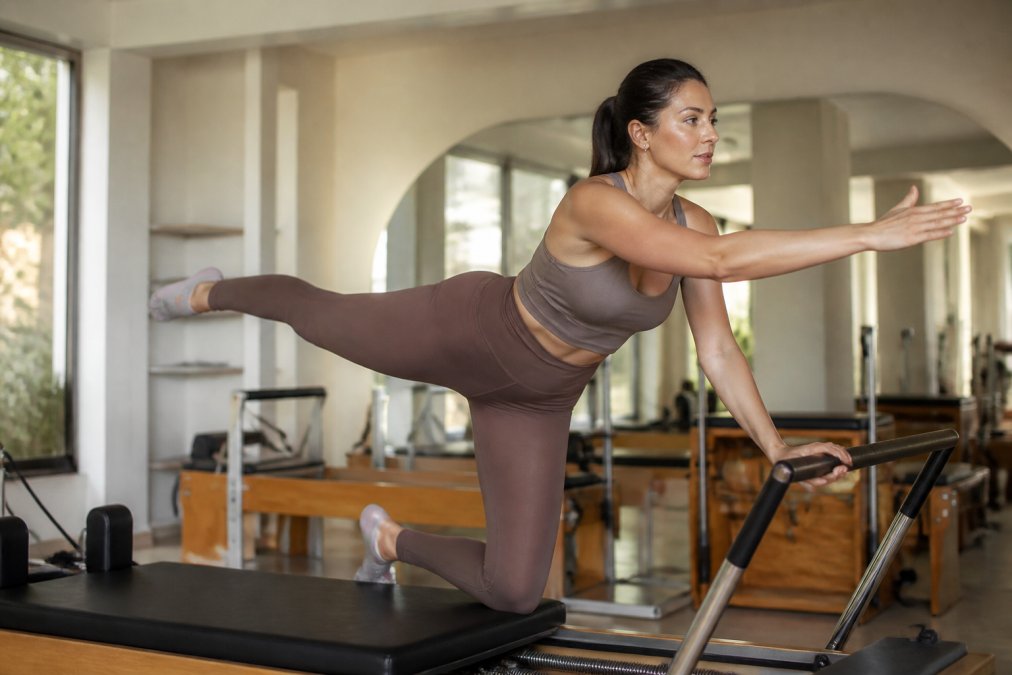
The catch: none of these benefits appear if the fit is wrong. A pair that is too tight restricts movement and cuts off circulation; too loose, and it behaves like an ordinary legging with a premium label.
How to Choose Pilates Activewear That Actually Works
Start with the movement, not the label. Choose Pilates activewear by matching the compression level to your session type, then verifying the fabric weight, waistband construction, and sizing before you buy.
Use this checklist before checkout:
- Match compression level to your practice: light support for gentle flows, firmer support for reformer or high-intensity work
- Check fabric weight and elasticity: heavier knits hold shape longer; thin fabric loses fit integrity faster
- Inspect seam construction: flatlock or seamless builds reduce chafing during seated and supine poses
- Confirm waistband stability: a wide, high-rise band resists rolling in forward folds
- Read the sizing note: many compression leggings run small, so size up for a true-to-size feel
- Look for moisture-wicking fabric if you sweat heavily
- Check the care instructions to protect elasticity over time
Best Leggings for Pilates: Top Picks That Support Your Practice
The best leggings for Pilates combine stable waistbands, four-way stretch, and a compression level that matches your session. SheRoar by Black Lion builds its leggings around exactly these priorities, from seamless knits to high-waist compression with pockets.
Here is how the current lineup compares:
| Style | Price | Key Feature | Best For |
|---|---|---|---|
| High-Waist Compression Leggings with Pockets | $52.99 | 220gsm nylon-spandex, welt pockets | Reformer classes, errands after |
| Seamless Knitted Peach Hip Yoga Pants | $44.89 | Seamless knit, peach-hip contouring | Seated poses, smooth silhouettes |
| Women's High-Hip Elastic Tight Breathable Sports Pants | $39.99 | High-hip compression, breathable stretch | HIIT circuits, cycling, rowing |
| Peach Hip-Lift Running Fitness Leggings | $32.95 | Contoured hip-lift seaming, quick-dry | Running and cardio days |
| Women's High-Waist Cycling and Yoga Leggings | $29.95 | High-rise compressive band, four-way stretch | Yoga flows, cycling, everyday wear |
Common Mistakes to Avoid When Buying Compression Leggings
The most common mistake is treating "tight" and "compression" as the same thing. A cheap, tight legging squeezes uniformly and restricts movement; real compression follows a graduated pressure profile that supports circulation without cutting it off. Here is how to tell the difference, and the other errors that show up again and again.

Frequently Asked Questions
Are compression leggings better than regular leggings for Pilates?
Compression leggings offer graduated pressure that supports circulation and muscle recovery, which can help during low-impact Pilates. They also provide proprioceptive feedback for better alignment and postural control. Regular leggings are comfortable but lack targeted support. For Pilates, compression leggings are generally better because they combine stability with breathability, especially in moves that demand single-leg balance and core engagement.
Do compression leggings restrict movement during Pilates?
No, quality compression leggings are designed with four-way stretch and a compression profile that moves with you. They should not restrict range of motion. Look for fabrics with high elasticity and seamless construction, like the Seamless Knitted Peach Hip Yoga Pants, which allow deep squats and wide-leg poses without pulling. The key is proper sizing: too tight causes restriction, too loose reduces benefits.
Who should avoid wearing compression leggings during exercise?
People with circulatory conditions such as peripheral artery disease or deep vein thrombosis should consult a doctor before wearing compression leggings. Those with skin sensitivities or open wounds on the legs may also want to avoid them. If you have any medical condition affecting blood flow, check with a healthcare provider. For most healthy individuals, compression leggings are safe and beneficial for Pilates and other low-impact workouts.
How should Pilates leggings fit for optimal performance?
Pilates leggings should fit snugly but not cut off circulation. The waistband should sit flat without rolling, and the fabric should stay opaque during deep bends. For compression leggings, you want a graduated pressure feel: firmer at the calf and lighter at the thigh. If you are between sizes, size up for a more relaxed fit. The High-Waist Compression Leggings with Pockets run true to size and offer a squat-proof fit.
What are the best leggings for Pilates that also work for daily wear?
The best leggings for Pilates transition easily to daily wear. Look for moisture-wicking, four-way stretch fabrics with a high-waist design that stays put. The Women's High-Waist Cycling and Yoga Leggings offer a compressive waistband and sculpting fit that works from class to errands. For a seamless option, the Seamless Knitted Peach Hip Yoga Pants provide contouring lift and comfort for all-day wear.