Athleisure vs Performance Wear for Everyday Use: 2026 Guide

Table of Contents
- Athleisure vs Performance Wear for Everyday Use: The Short Answer
- Athleisure vs Performance Wear: Side-by-Side Comparison
- The Benefits of Moisture-Wicking Fabrics for Daily Wear
- How to Style Activewear for Work Without Breaking Dress Codes
- Performance Wear Durability vs Comfort: What Lasts and What Feels Good
- Cost Per Wear, Longevity, and Sustainability
- Fit by Body Type: Bras, Waistbands, and Staying Put
- Conclusion
- Frequently Asked Questions
Last Updated: September 12, 2026
Athleisure vs Performance Wear for Everyday Use: The Short Answer
The distinction between athleisure vs performance wear comes down to intent: athleisure is designed to look good in daily life, while performance wear is engineered to function under physical stress. Performance wear wins for high-intensity training; athleisure wins for everything else.
Athleisure vs Performance Wear: Side-by-Side Comparison
Athleisure prioritizes aesthetic appeal and versatility; performance wear prioritizes function. The differences show up in fabric, construction, and how the garment behaves after repeated wear.
| Feature | Athleisure | Performance Wear |
|---|---|---|
| Primary goal | Style and versatility | Function under load |
| Fabric focus | Fabric blends, comfort | Moisture-wicking, compression |
| Typical fibers | Cotton blends, spandex | Polyester, nylon, spandex |
| Best for | Gym-to-street transition | High-intensity training |
| Durability demand | Moderate | High |
Fabric Technology: Synthetic Fibers, Spandex, and Four-Way Stretch
Performance wear leans on synthetic fibers such as polyester and nylon, often blended with spandex for four-way stretch and recovery, built for moisture-wicking and thermal regulation during high-intensity training (PubMed). Athleisure uses similar fibers but softens them with cotton or looser knits for daily comfort. A legging engineered for compression holds its shape longer but may feel less like something you'd wear to lunch. A pair like the Crossover Flared Legging sits in the middle, using a nylon-elastane blend that keeps its shape through a session while still reading as everyday wear.

Design, Aesthetic Appeal, and Wardrobe Staples
Athleisure is where aesthetic appeal leads the design brief: silhouette, colorway, and styling flexibility matter as much as function. Performance wear favors ergonomic design, chafe-reducing seams, and fit that stays put under movement. Athleisure pieces become wardrobe staples you rotate all week; performance pieces are reserved for demanding sessions. The Women's Mesh-Panel Slim-Fit Leggings illustrate the hybrid approach: mesh panels add breathability, but the pencil silhouette is designed to be seen off the mat too.

The Benefits of Moisture-Wicking Fabrics for Daily Wear
Moisture-wicking fabrics move sweat away from the skin instead of trapping it, keeping you drier during everyday activity. Walking to the train, carrying groceries, or chasing a toddler all produce sweat, and a cotton legging holds that moisture against your skin. Synthetic fibers dry faster and reduce the clammy feeling that makes people want to change the moment they stop moving. Anti-microbial finishes also help control odor between washes, meaning fewer outfit changes and less laundry (PubMed). The Women's High-Waist Yoga Pants With Invisible Pleats apply this logic: stretch fabric with recovery that returns to shape after a full class or a hike, so the pant works all day.

How to Style Activewear for Work Without Breaking Dress Codes
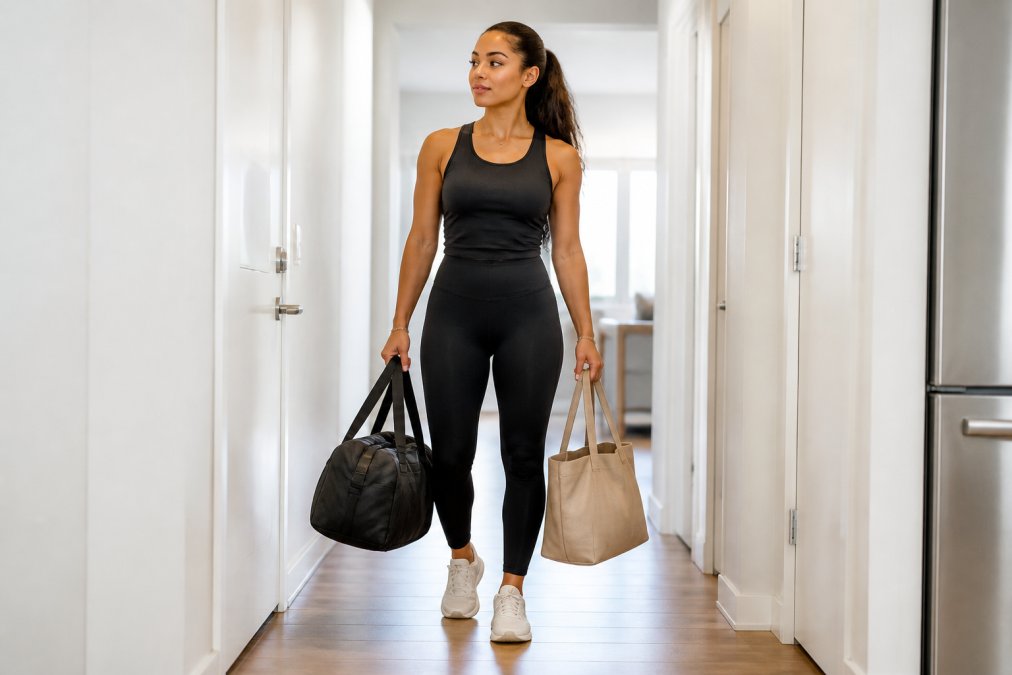
Styling activewear for work comes down to three rules: cover the compression zones, choose structured silhouettes, and keep the palette neutral. Most dress codes object to visible athletic branding and exposed skin, not the fabric itself. Start with a dark, full-length legging that reads as a trouser, add a blazer or longline shirt that covers the waistband, and swap the running shoe for a loafer or clean sneaker. The Black Solid Women's Cutout Leggings work because the full-length trouser cut reads closer to tailored than athletic. The Casual Sexy Women's Ripped Leggings are better saved for casual Fridays.
The Dress-Code Spectrum: Where Athleisure Actually Fits
Dress codes sit on a spectrum, and the same legging can pass in one and fail in another. The three tiers that matter for everyday athleisure are business casual, smart casual, and creative casual.
Business casual is the strictest tier where athleisure can survive. The fabric may be technical, but the silhouette must read as tailored: full-length, opaque, dark-colored bottoms with no visible logos, paired with a structured top layer. A ponte-style or high-waist legging in black or charcoal works because it mimics a slim trouser's line. A cropped legging, bike short, or anything with a visible waistband logo does not. If your office has a written dress code, "no athletic attire" usually targets branding and exposed skin, not fabric composition.
Smart casual is the middle tier and the most forgiving. A clean legging with a tucked-in button-down, knit blazer, or longline cardigan reads as intentional, the trick is making the athletic piece the base layer rather than the statement. A high-waist legging under a mid-length blazer, finished with a loafer or minimal leather sneaker, passes in most smart-casual offices. This is where the Women's Mesh-Panel Slim-Fit Leggings can work, because the pencil silhouette reads closer to a tailored pant.
Creative casual is the loosest tier, agencies, studios, tech offices, and most remote-first workplaces. Joggers, flared leggings, and clean sneakers are standard; the only rule is that the piece should look deliberate rather than like you rolled out of bed. A Crossover Flared Legging with a fitted tee and a denim jacket reads as styled.
The Four-Point Dress-Code Test
Before you wear an athletic piece to work, run it through four checks:
- Opacity. Bend, squat, and sit in front of a mirror under bright light. If you can see through the fabric, it is a gym piece.
- Branding. Any visible logo, reflective strip, or slogan pushes the piece toward athletic. Small tonal logos usually pass.
- Silhouette. Does the piece read as a trouser, skirt, or tailored pant? If it reads as a legging, it belongs in the creative-casual tier at best.
- Top half. If you would feel comfortable walking into a meeting without changing your top, the bottom half is probably work-appropriate.
Styling Moves That Upgrade an Athletic Piece
A few concrete swaps do most of the work. Replace a hoodie with a knit blazer or structured cardigan, a running shoe with a loafer, ballet flat, or minimal leather sneaker, and a sports bra worn as a top with a fitted tee or button-down. Add a belt over a high-waist legging to break the athletic line, and keep the palette to two or three neutral tones, black, charcoal, navy, camel, or cream, because busy colorways read as gym wear faster than any silhouette.
What to Avoid
Avoid exposed waistbands, visible compression seams, reflective details, and wearing a sports bra as an outer layer above creative casual. Avoid matching sets in business-casual or smart-casual offices, a matching set reads as athletic even when each piece would pass alone. The difference between a piece that passes at work and one that doesn't is usually construction and color, not the label.
Performance Wear Durability vs Comfort: What Lasts and What Feels Good
Performance wear generally outlasts athleisure because it uses denser knits and stronger fibers, but it often feels less comfortable against the skin. Durability comes from fabric weight, seam construction, and fiber recovery; comfort comes from softness, breathability, and how the garment moves with the body. You can have both, but it usually costs more, because achieving both requires better textile engineering. A soft athleisure legging worn for repeated high-intensity training will lose its shape faster than a piece built for that load.
Cost Per Wear, Longevity, and Sustainability
Cost per wear is the most honest way to judge activewear value: divide the price by the number of times you actually wear the piece. A cheaper legging worn ten times before it sags costs more per wear than a better-made one worn a hundred times. Garments that hold their shape and color longer stay in rotation longer, meaning fewer replacements and less textile waste. Buy fewer pieces, choose fabric blends with real recovery, and rotate them rather than wearing the same pair daily.
How to Calculate Cost Per Wear for Activewear
The formula is simple: cost per wear = purchase price ÷ number of wears before the garment fails. The hard part is estimating the denominator. For activewear, a piece "fails" when it sags at the knee, loses opacity, pills at the inner thigh, or stops recovering after a wash. A well-constructed performance legging typically holds its shape through roughly 100 to 150 wears with cold washing and air drying, while a budget athleisure legging often shows sag or pilling between 30 and 50 wears.
A budget legging worn 40 times before it sags has a higher cost per wear than a better-made legging worn 120 times, even if the better-made piece costs several times more up front. The pattern holds across price tiers: the piece that survives more wears usually wins on cost per wear, provided you actually wear it that many times. A durable piece you avoid because it is uncomfortable has an infinite cost per wear.
The Lifecycle: Where Performance and Athleisure Diverge
Performance wear and athleisure have different environmental profiles at every stage of the garment's life.
Materials. Performance wear leans on synthetic fibers, polyester, nylon, elastane, which are petroleum-derived and do not biodegrade. Athleisure often blends those synthetics with cotton or modal, reducing the synthetic share but introducing trade-offs: cotton is water-intensive to grow, and cotton-synthetic blends are harder to recycle than pure-fiber garments. Neither category is clean; the relevant question is which piece stays in use longer.
Washing. Synthetic fabrics shed microplastics in the wash, and shedding increases with every cycle (europa.eu). A piece worn 120 times sheds more over its life than one worn 40 times, but the durable piece replaces three or four short-lived pieces, so total shedding across the same number of wears is usually lower. Cold washing and air drying reduce shedding and fiber breakdown.
End of life. Most activewear is not curbside recyclable because of elastane content. Some brands run take-back programs, but most leggings end up in landfill. Longevity is the single highest-leverage sustainability decision a consumer can make: the piece you keep wearing is the piece that does not become waste.
A Practical Buying Framework
A simple framework for everyday use:
- Buy for rotation, not for storage. Five to seven bottoms in regular rotation beats a large set you wear rarely.
- Prioritize recovery over softness for high-use pieces. Blends with higher elastane and denser knit hold shape longer; softer, looser knits feel better on day one but sag sooner.
- Match the piece to the load. Reserve the densest, most technical pieces for high-intensity training and let softer athleisure handle errands and desk days.
- Wash cold, skip the softener, air dry. This habit extends garment life more than any fabric upgrade.
- Rotate, don't repeat. Wearing the same pair daily accelerates fiber fatigue; rotating three or four pairs spreads the load.
The Sustainability Bottom Line
Sustainability in activewear is not primarily about which fiber a garment is made from, it is about how long the garment stays in use. A synthetic performance legging worn 150 times has a lower environmental cost per wear than a natural-fiber athleisure piece worn 20 times and replaced. The most sustainable purchase is the one you actually wear, which is why comfort, fit, and versatility matter as much as fabric composition when choosing between athleisure and performance wear for everyday use.
Fit by Body Type: Bras, Waistbands, and Staying Put
The right fit depends on body type, activity, and waistband construction, not the size on the label. Waistbands that roll or leggings that slide usually fail because the band lacks structure or the rise doesn't match your torso length. A crossover or high-waist construction holds better than a thin elastic band because it distributes tension across a wider area. For bras, support comes from band fit first, then cup shape, then strap adjustment; many women find sizing up in the band and down in the cup solves shifting. SheRoar by Black Lion builds its leggings with this in mind.
Conclusion
Finding activewear that works for both training and daily life is harder than it should be, and most wardrobes end up split between pieces that perform and pieces that look right. SheRoar by Black Lion designs for that gap, with premium activewear, shapewear, and apparel built to move between the gym and everything after it. New styles drop weekly, and every piece is backed by a supportive community and SheRoar Fitness resources with workout videos and tips. See the full catalog and dress the woman you are becoming.
Frequently Asked Questions
What is the main difference between athleisure and performance wear?
Performance wear is engineered for a specific activity: moisture-wicking synthetic fibers, four-way stretch, compression technology, and seam construction built for high-intensity training. Athleisure borrows some of that engineering but prioritizes aesthetic appeal and versatility, so a piece reads intentionally outside the gym. In practice, the lines blur. A seamless legging with a crossover V-waist can handle a yoga flow and still look deliberate with a blazer, which is exactly the overlap most shoppers are looking for.
Can you wear performance gear as everyday clothing?
Yes, with small adjustments. Technical pieces work for daily wear when the fit is relaxed enough to sit, drive, and eat in, and when the fabric does not look like race-day kit. Pair a high-waist legging with a knit sweater instead of a gym tank, and swap trainers for a clean sneaker or boot. The one thing to watch is compression: a tight race-day short is uncomfortable after two hours in a chair, while a mid-waist sculpting legging moves with you all day.
What are the benefits of moisture-wicking fabrics for daily wear?
Moisture-wicking fabrics pull sweat away from your skin instead of holding it against you, so you dry faster and stay comfortable through commutes, errands, and long days on your feet. Polyester, nylon, and spandex blends also resist the clammy feel cotton gets once it is damp, and many are treated with anti-microbial finishes that keep odor down between washes. For everyday use, the practical win is fewer outfit changes: one legging handles a morning class and an afternoon of errands.
How do I style performance wear for a casual look?
Treat technical pieces as the base layer of a normal outfit. A black mesh-panel legging reads as a slim trouser under an oversized blazer and chunky sneakers. A flared seamless legging pairs with a cropped knit and a long coat. Keep the palette tight, black, gray, mocha, so the fabric technology disappears into the look, and add one structured piece, a jacket, a belt bag, a button-down, so the outfit does not read as gym-only.
Does performance wear lose its effectiveness if worn casually?
The fabric does not stop wicking because you wore it to brunch. What wears technical gear out is washing, not wearing. Heat and fabric softener break down spandex and clog wicking finishes faster than a full day in a chair. Wash cold, skip the softener, and air dry, and a nylon-elastane blend keeps its four-way stretch and recovery through both workouts and everyday use.