What Happens If You Wear the Wrong Sports Bra?

Table of Contents
- What Happens If You Wear the Wrong Sports Bra?
- 1. Straps That Slip, Dig In, or Leave Shoulder Grooves
- 2. Band Problems: Riding Up, Pinching, or Pressure Marks
- 3. Cup Fit Issues: Spillage, Gaping, and Compression
- 4. How Should a Sports Bra Fit? The Non-Negotiables
- 5. Sports Bra Too Tight Symptoms: What Your Body Is Telling You
- 6. Sports Bra Too Loose Symptoms: When Support Disappears
- 7. How to Measure for a Sports Bra (And When to Size Up)
- Frequently Asked Questions
Last Updated: October 14, 2026
What Happens If You Wear the Wrong Sports Bra?
Wearing the wrong sports bra can cause breast tenderness, shoulder grooves, chafing, and back or neck pain over time. It also means your breasts move more than they should during exercise, which many women describe as uncomfortable rather than painful. At SheRoar by Black Lion, we hear the same story from customers again and again: the bra looked fine in the mirror, but something felt off by the second mile.

That gap between how a bra looks and how it actually performs is what this guide is about. Below, we break down the specific signs of a poor fit, what each one is telling you, and how to fix it fast.
A sports bra is a piece of activewear designed to limit breast movement during physical activity using compression, encapsulation, or a mix of both. When it fits correctly, it should feel secure without pinching, digging, or riding up.
1. Straps That Slip, Dig In, or Leave Shoulder Grooves
Slipping straps are usually a band problem, not a strap problem. If the band is too loose, it can't anchor the bra, so the straps take the load instead.
Watch for these signs:
- Straps that slide off your shoulders mid-workout
- Deep red grooves that stay after you take the bra off
- Numbness or tingling in your arms or hands
- Headaches that start during or after training
That last one surprises people. Strap pressure on the nerves and muscles around the shoulder can refer tension upward, and many women don't connect the two.
2. Band Problems: Riding Up, Pinching, or Pressure Marks
A band that rides up in the back is too loose. A band that leaves deep red marks or makes it hard to take a full breath is too tight.
The band should sit level all the way around and stay put when you raise your arms. If you can pull it more than a couple of centimetres away from your ribs, it's not doing its job.
Signs your band is the problem:
- The back of the bra climbs toward your shoulder blades
- You feel pressure marks that last for hours
- The bra shifts when you lift your arms overhead
- You're constantly tugging it down
Band pressure that's too high can also cause skin irritation and chafing along the ribcage, especially on longer runs or high-sweat sessions.
3. Cup Fit Issues: Spillage, Gaping, and Compression
Cup problems show up in two opposite ways, and both matter. Spillage means tissue is escaping over the top or sides. Gaping means the cup stands away from your chest.
Compression-only bras flatten everything into one shape. That works for some bodies and some activities, but it can cause breast tenderness if the compression is uneven.
Where the fit goes wrong:
- Spillage: the cup is too small or too shallow
- Gaping: the cup is too large or the wrong shape
- Underwire digging: the wire sits on breast tissue instead of your ribcage
- Uniboob: a compression bra with no separation, common in cheaper styles
A wire-free design avoids the underwire problem entirely. Our Women's Wire-Free Shockproof Yoga Sports Bra uses a gathering construction that shapes and lifts without a wire pressing into your ribcage.
4. How Should a Sports Bra Fit? The Non-Negotiables
A sports bra should fit snugly on the loosest hook, sit flat against your ribcage, and hold your breasts without flattening or spilling them. You should be able to breathe deeply and move your arms freely.

Here's the quick test. Do it in front of a mirror:
- The band sits level and doesn't ride up when you raise your arms
- You can fit two fingers under the band, but no more
- Straps stay on your shoulders without digging
- The centre front lies flat against your chest
- No tissue spills over the top or sides of the cups
- No gaping when you lean forward
- You can take a full, deep breath without restriction
If you failed two or more checks, the bra is the wrong size or the wrong style for your activity.
Women's Wire-Free Shockproof Yoga Sports Bra →
5. Sports Bra Too Tight Symptoms: What Your Body Is Telling You
A sports bra that's too tight causes pressure marks, restricted breathing, chafing, and nerve symptoms like tingling in the arms. These are not signs of good support. They're signs of a bad fit.
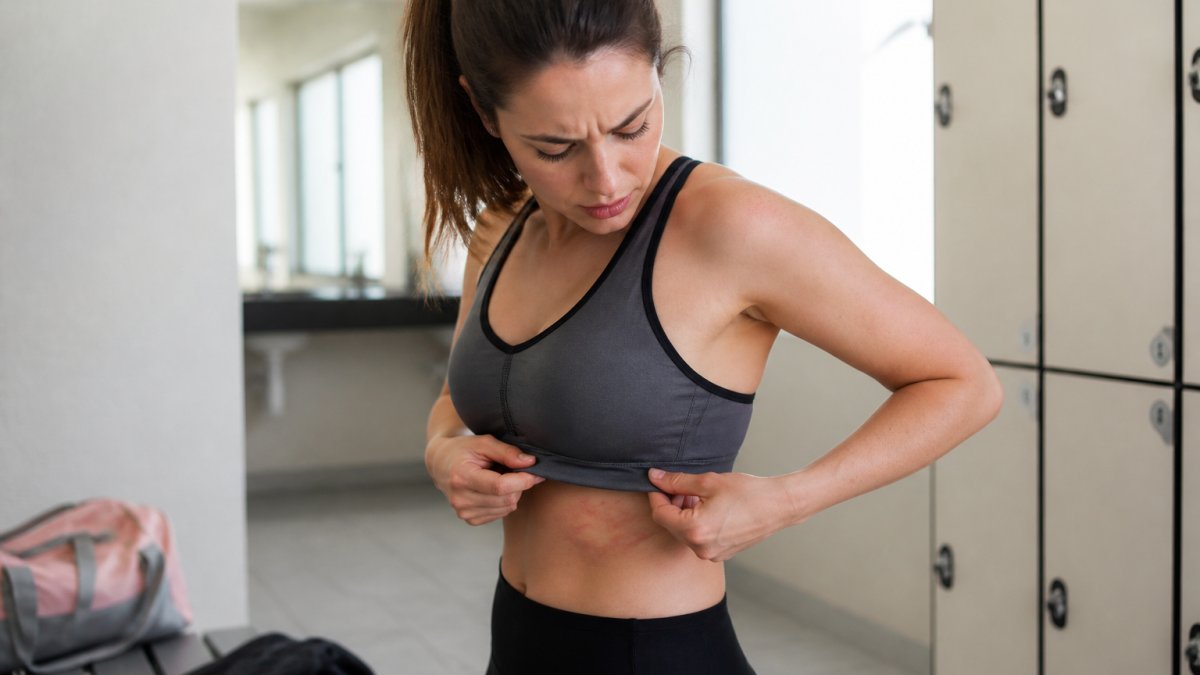
Look for:
- Red marks that don't fade within an hour of removing the bra
- Shallow breathing or a feeling of restriction during cardio
- Chafing or raw skin along the band line
- Tingling, numbness, or cold hands during exercise
- Headaches that build through a session
One more thing worth knowing: many women assume a tighter bra means more support. It doesn't. Support comes from the band sitting correctly and the cups holding tissue in place, not from squeezing harder.
6. Sports Bra Too Loose Symptoms: When Support Disappears
A sports bra that's too loose lets your breasts move more than they should, which leads to tenderness, discomfort, and distraction during training. You'll notice bouncing, shifting, and constant readjusting.
Tell-tale signs:
- Your breasts move noticeably during jumping, running, or burpees
- The bra shifts or twists as you move
- You're pulling it down or adjusting it every few minutes
- The band gapes at the back
- Straps fall off your shoulders
Impact level matters here. A bra that's fine for yoga may not hold up for running. If you train across different intensities, you likely need more than one bra.
For running and HIIT, our High-Impact Wire-Free Sports Bra uses a nylon-spandex blend that stretches and recovers, with built-in removable pads and support suited to A through F cups.
7. How to Measure for a Sports Bra (And When to Size Up)
To measure for a sports bra, wrap a soft tape around your ribcage just under your bust for the band size, then around the fullest part of your bust for the cup. Measure in centimetres for accuracy.
Do this once every six months, or after any noticeable change in weight or training load.
A few practical notes:
- Wear an unpadded bra or no bra when you measure
- Keep the tape level and snug, not tight
- Round the band measurement to the nearest even number
- Re-measure if your current bra leaves marks or gaps
When to size up: if you can't fit two fingers under the band, if the cups spill, or if the bra leaves deep marks after 30 minutes of wear. Some brands also run small. Our Wire-Free Shockproof Sports Bra - Full Cup runs one size smaller than US/EU sizing, so going up one is the right call.

| Problem | Likely Cause | Fix |
|---|---|---|
| Band rides up | Band too loose | Size down in the band |
| Straps dig in | Band too loose, straps overworked | Tighten band, loosen straps |
| Spillage over cups | Cup too small | Size up in the cup |
| Gaping cups | Cup too large or wrong shape | Try a different cup style |
| Tingling in arms | Straps too tight | Loosen straps, check band fit |
| Bouncing during runs | Not enough impact support | Switch to a high-impact bra |
Frequently Asked Questions
What happens if you wear the wrong sports bra?
Wearing the wrong sports bra can cause shoulder pain, neck strain, back discomfort, breast tenderness, chafing, and skin irritation. A band that rides up or straps that dig in create pressure points that worsen with movement. Over time, poor support can contribute to posture changes like rounded shoulders and muscle strain. The right fit distributes weight evenly and keeps breast movement controlled.
How can you tell if a sports bra is too small?
Signs a sports bra is too small include cup spillage, straps that dig into your shoulders, a band that leaves deep red marks, difficulty breathing deeply, and chafing along the edges. You might also notice breast tenderness after workouts or numbness in your arms. If you need to adjust constantly or feel compressed rather than supported, size up or try a different style.
Can the wrong sports bra cause breast pain?
Yes. A sports bra that is too loose allows excessive breast movement, which stretches supportive tissue and causes tenderness. A bra that is too tight compresses breast tissue and restricts circulation, also leading to pain. Both extremes can contribute to discomfort during and after exercise. Proper support limits movement without squeezing, which helps prevent pain.
How often should you replace a sports bra?
Replace a sports bra every 6 to 12 months with regular wear, or sooner if the band stretches out, straps lose elasticity, or the fabric pills and loses shape. High-impact activities and frequent washing shorten lifespan. Rotating between two or three bras extends their usefulness. If your bra no longer holds its shape or you need to tighten straps constantly, it is time for a new one.
Finding the right sports bra comes down to fit, not price or branding. If your current bra leaves marks, slips, or lets you bounce, it's the wrong one, and your body is already telling you so. SheRoar by Black Lion builds wire-free, shockproof sports bras in sizes from S to 5XL, with styles for low, medium, and high-impact training, plus a fitness resource library to support your routine. See the full catalog and dress the woman you are becoming.