Shapewear vs Bodysuits for Daily Smoothing: 2026 Guide

Table of Contents
- Quick Comparison: Shapewear vs Bodysuits for Daily Smoothing
- What Is the Difference Between Shapewear and Bodysuits?
- Support Levels: Compression vs Sculpting vs Smoothing
- Comfortable Shapewear for Everyday Wear: What to Look For
- Breathable Shapewear Fabrics and Moisture-Wicking Technology
- How to Style Shapewear Bodysuits Under Different Outfits
- Choosing the Right Option for Your Body Type and Daily Routine
- Skin Health, Hygiene, and Long-Term Wear Considerations
- Frequently Asked Questions
Last Updated: September 22, 2026
Quick Comparison: Shapewear vs Bodysuits for Daily Smoothing
Shapewear is a compression undergarment built to shape the body; a bodysuit is a one-piece top that covers the torso and often snaps at the crotch. That overlap is why the shapewear vs bodysuits for daily smoothing debate confuses shoppers.
| Feature | Shapewear | Bodysuit |
|---|---|---|
| Main purpose | Smooth and shape under clothes | Serve as the outfit or base layer |
| Coverage | Targeted: waist, hips, midsection | Full torso, sometimes with sleeves |
| Compression | Firm to light, depending on style | Light to moderate |
| Crotch access | Often open or hook-and-eye | Usually snap closure |
| Best for | Fitted dresses, workwear, events | Jeans, skirts, casual daily wear |
What Is the Difference Between Shapewear and Bodysuits?
Shapewear is an undergarment engineered with compression panels to smooth the midsection, waist, and hips. A bodysuit covers the torso like a shirt but stays tucked, with a crotch closure for bathroom access. Shapewear is hidden; a bodysuit is seen.
Garment Construction and Intended Use
Construction tells you which one you are holding. Shapewear uses graduated compression zones, seamless bonding, and firm knit panels at the waist or abdomen. A bodysuit uses softer jersey or ribbed knits with a snap closure and a neckline meant to show. Shapewear sits under a fitted dress or trousers; a bodysuit replaces the tucked-in shirt under jeans or a skirt.
Support Levels: Compression vs Sculpting vs Smoothing
Compression is the firmest level and actively cinches the body. Sculpting is mid-level, reshaping the waist and seat without heavy pressure. Smoothing is the lightest, flattening lines with barely any squeeze.
- Light smoothing: under t-shirts, casual dresses, and loose trousers
- Sculpting: under fitted dresses, workwear, and denim
- Firm compression: short events, photos, and specific outfits
Comfortable Shapewear for Everyday Wear: What to Look For
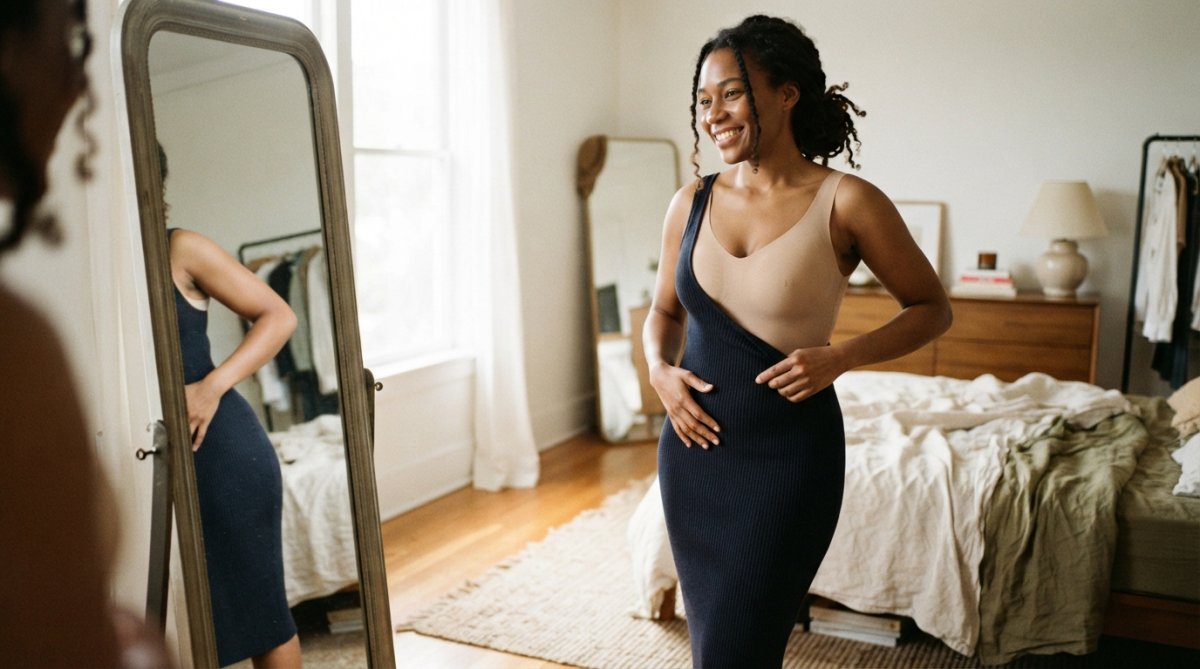
Comfortable shapewear for everyday wear comes down to four things: a waistband that doesn't roll, a crotch that lets you use the bathroom without undressing, straps that stay put, and a torso length that matches your own.
Adjustable Straps, Crotch Access, and Torso Length
Adjustable straps tune the lift without digging into the shoulders. Crotch access, whether a snap closure or an open gusset, decides whether you can wear the piece through a full workday. Torso length decides whether the waistband lands on your natural waist or fights your ribs.
Run this checklist before you buy:
- Waistband sits flat when you sit down, not just when you stand
- Crotch closure opens without removing the garment
- Straps adjust and stay adjusted through movement
- Torso length matches your measurement, not the model's
- No visible ridge under your thinnest fitted dress
Breathable Shapewear Fabrics and Moisture-Wicking Technology
Breathable shapewear fabrics use knit structures that move air and moisture away from the skin rather than trapping it. Look for nylon and spandex blends, moisture-wicking finishes, and seamless construction that reduces friction. Nylon gives shape memory, spandex delivers stretch, and polyester blends hold their shape and dry quickly, which is why the SheRoar High Waist Shapewear Bodysuit uses a 90% polyester fabric that keeps its shape through repeated wear and washing.

A few practical rules:
- Seamless knits reduce chafing under fitted clothing
- Moisture-wicking matters most if you wear shapewear to work or through warm months
- Thin jersey knits disappear under clothing but shape less
- Firm knits shape more but need a breathable blend to stay wearable
How to Style Shapewear Bodysuits Under Different Outfits
Styling a shaping bodysuit is about matching the neckline and compression level to the outfit. For strapless or thin-strap tops, the Strapless Seamless Firm-Control Shaping Bodysuit sits below the shoulder and stays hidden, with a wire-free, cupless build that avoids underwire pressure and padding bulk.
Three outfit formulas that work:
- Bodycon dress: full one-piece shapewear, seamless finish, no visible lines
- Jeans and a blazer: shaping bodysuit as the top layer, tucked, no bunching
- Workout set: high-waist shaping bodysuit under leggings, breathable knit
Choosing the Right Option for Your Body Type and Daily Routine
The right choice depends on three measurements most shoppers never take: torso length, bust-to-waist ratio, and hours of wear. "Know your body type" fails because two women with the same dress size can need completely different cuts. Measure for smoothing, not sculpting, the garment should follow your frame, not fight it.
How to Measure for Smoothing vs. Sculpting
Torso length is the distance from the hollow at the base of your throat to your natural waist, then from your natural waist to your hip bone. Most shapewear failures happen because a piece is built for a 12-inch rise and the wearer has a 15-inch torso, so the waistband migrates into the ribs by mid-morning.
Matching the Cut to Your Proportions
- Long torso (over 13 inches from underbust to hip): choose a high-waist or full one-piece style. Short briefs will roll down because there is not enough fabric to anchor. Look for pieces described as "high-waist" or "full torso" rather than "mid-waist."
- Short torso (under 11 inches from underbust to hip): a brief or mid-waist cut sits better than a full bodysuit, which will bunch at the waist and create the exact lines you are trying to hide.
- Fuller bust (D cup or above): look for built-in chest support or a style that explicitly says it needs no separate bra. A piece without bust structure will compress the chest and create a flattened, uncomfortable silhouette.
- Curvier hips (hip measurement 10+ inches larger than waist): hip-lifting construction adds definition without padding. Avoid styles with heavy compression at the hip line, which can create a visible indent under fitted dresses.
- Straight or athletic build (less than 6-inch waist-to-hip difference): light smoothing works better than firm sculpting. Heavy compression on a straight frame tends to create new lines rather than remove them.
The Daily Routine Factor
Hours of wear should override body type when the two conflict. A piece that fits perfectly but is rated for firm control will still dig in after eight hours. For workdays and errands, stay in the light-to-moderate range and save firm compression for events under four hours. Most women who wear shaping daily own one firm piece for occasions and two or three light smoothing pieces for rotation, that rotation matters for comfort and fabric recovery.
Waist-Cinching Hip-Lifting One-Piece →
Sizing Nuances for Specific Body Shapes
Sizing is where most returns happen, so treat it as the deciding factor.
- Long torso: choose a high-waist or full one-piece style; short briefs will roll
- Short torso: a brief or mid-waist cut sits better than a full bodysuit
- Fuller bust: look for built-in chest support, like the Slimming Butt-lifting One-piece Shapewear, which needs no separate bra for most outfits
- Curvier hips: hip-lifting construction adds definition without padding
- Between sizes: size up for daily wear, size true for one-off events
Skin Health, Hygiene, and Long-Term Wear Considerations
Skin health is the part of daily smoothing that gets almost no coverage. Compression garments trap heat and moisture against the skin, and wearing one for twelve hours without a break is the fastest route to irritation. The fix is choosing pieces that work with your body rather than against it.
What Happens Under Compression
When a garment presses against skin, three things happen: airflow drops so sweat cannot evaporate, friction increases at seams and edges, and if the fit is too tight, pressure points develop at the waistband, under the bust, and at the crotch line.
Moisture-Wicking and Fabric Recovery
Moisture-wicking describes a knit structure that pulls sweat away from the skin and spreads it across the fabric surface so it evaporates faster. Nylon and spandex blends with a wicking finish do this well; cotton holds moisture and dries slowly, which is why all-cotton shapewear is rare. Fabric recovery matters just as much, a garment that loses its stretch after five washes will bag and shift, creating new friction points.
A Daily Hygiene Routine That Works
A dermatologist-informed approach to daily wear looks like this:
- Rotate two or three pieces so each fully dries between wears. Elastic needs 24 hours to recover its shape.
- Wash after every wear, especially in warm months. A gentle cycle in a mesh bag protects the knit structure.
- Take it off for a few hours when you can. Even a lunch break without compression helps skin recover.
- Never sleep in firm-control shapewear. Your body needs unrestricted circulation overnight.
- Stop wearing any piece that leaves lasting marks or numbness. That is a fit problem, not a toughness problem.
The U.S. Food and Drug Administration guidance on textile and garment safety covers labeling and material safety for clothing sold in the US, which is a useful reference point when a fabric blend or care label looks unclear.
The Transition from Shapewear to Casual Wear
That is also where the transition from shapewear to casual wear matters. A light smoothing bodysuit can replace a tucked shirt under jeans, meaning fewer layers and less heat against the skin. When a bodysuit becomes the outfit, you are not stacking compression under compression, you are wearing one breathable layer that smooths and covers, reducing the time your skin spends under pressure and cutting down on laundry.
Long-Term Wearability Checklist
- Fabric lists nylon or polyester first, with spandex for stretch
- Seams are bonded or flat-locked, not raised
- You can sit, bend, and breathe without the waistband digging
- The piece dries fully within a few hours of washing
- You own at least two pieces so you can rotate
- You remove it for at least a few hours each day
Skin health is not a reason to avoid daily smoothing, it is a reason to choose pieces built for it.
Frequently Asked Questions
Is a bodysuit considered shapewear?
A bodysuit becomes shapewear when it is built with compression panels, sculpting seams, or firm-control knit that smooths the midsection and waist. A plain fashion bodysuit offers no shaping. For daily smoothing, look for one-piece styles with tummy control and a seamless finish. SheRoar's Waist-Cinching Hip-Lifting One-Piece Shapewear combines waist compression, hip lift, and a seamless finish in one layer.
Can you wear shapewear every day?
Yes, if you choose comfortable shapewear for everyday wear. Look for breathable fabric, adjustable straps, and a crotch closure so you can use the bathroom without removing the garment. Firm-control pieces are best saved for events, while light-to-moderate compression works for daily smoothing. Rotate between two or three pieces and wash them regularly to protect both the fabric and your skin.
What is the difference between a shaping bodysuit and regular shapewear?
A shaping bodysuit covers your full torso in one piece, so it smooths the midsection, waist, and seat without rolling down or creating a waistband line. Regular shapewear, like high-waisted shorts or waist cinchers, targets specific zones. Bodysuits suit fitted dresses and high-waist pants; separate pieces work better under skirts or when you want lighter coverage.
Which is more comfortable for all-day wear: bodysuits or separate shapewear?
Bodysuits usually win for all-day wear because they stay in place and eliminate the waistband digging and rolling that separate pieces cause. The trade-off is bathroom access, so choose a bodysuit with a hook-and-eye closure. Breathable shapewear fabrics like nylon and polyester blends with moisture-wicking properties keep you cool. SheRoar's Strapless Seamless Firm-Control Shaping Bodysuit uses a seamless thin jersey knit that lies flat with no ridges.
How do I choose the right level of smoothing for daily use?
Match the support level to the outfit and the hours you will wear it. Light smoothing suits casual days and thin fabrics. Moderate compression, like SheRoar's Body-Shaping Tummy-Control Slimming Shapewear, handles workwear and fitted dresses. Firm control is for events and short wear. Always check the size note: several SheRoar pieces run one size smaller than US/EU, so size up for a true-to-size fit.