How to Stop Sports Bra Pads Shifting: 7 Fixes That Work

Table of Contents
- Why Sports Bra Pads Shift (And How to Fix It for Good)
- Quick Fixes: Secure Pads Without Sewing
- How to Sew Bra Pads Into Sports Bra: Step-by-Step
- How to Wash Sports Bras With Pads Without Ruining Them
- When the Bra Itself Is the Problem: Best Sports Bras for Large Chests
- Common Mistakes That Make Pad Shifting Worse
- Final Thoughts on Stopping Sports Bra Pads Shifting
- Frequently Asked Questions
Last Updated: September 7, 2026
Few annoyances in activewear match the moment you're mid-burpee and realize your sports bra pads have folded, bunched, or migrated toward your collarbone. How to stop sports bra pads shifting affects fit, comfort, and confidence during your workout. Pad migration is one of the most common fit complaints in the industry. The good news is that this problem is fixable, from a two-minute adjustment to a permanent sewing fix.

Shifting pads aren't usually a sign of a bad bra, they're a sign of a mismatch between the bra's construction, the pad shape, and your washing habits. Below are fixes, from temporary hacks like double-sided tape to permanent solutions like sewing, plus how to wash sports bras with pads so they last longer.
Why Sports Bra Pads Shift (And How to Fix It for Good)
Sports bra pads shift because of a combination of slick fabric friction, improper washing, and pad shapes that don't match the bra's liner pocket. When moisture-wicking fabric meets a smooth foam pad, there's little natural grip to hold it in place. Add a spin cycle, and you have a recipe for padding displacement.

The root causes break down into three categories:
- Washing damage: The tumbling action of a washing machine folds and creases pads
- Movement during wear: High-impact exercise creates repeated motion that works pads loose
- Design mismatch: Removable pads that are smaller or a different shape than the pocket they sit in
Understanding which cause applies to your bra tells you which fix will work. If pads shift only after washing, the problem is your laundry routine. If they shift mid-workout, you need a securing method or a different bra design altogether.
Quick Fixes: Secure Pads Without Sewing
These temporary fixes take under five minutes. They're ideal for bras you plan to replace soon or for testing whether a bra is worth keeping before committing to a permanent alteration.
The Material Matters: Choosing the Right Tape
A common mistake is using any double-sided tape on any bra. The slick, moisture-wicking synthetics used in most performance sports bras require a stronger adhesive than cotton or cotton-blend fabrics. Standard fashion tape may hold for yoga but fail during a sprint.
- For synthetic performance fabrics (nylon, polyester, spandex): Look for a tape specifically designed for activewear or medical-grade silicone tape. Silicone tape provides a high-friction grip that adheres well to smooth synthetics without leaving a sticky residue. Brands like Holo (made for activewear) or KT Tape (a sports kinesiology tape) offer strips that are designed to withstand sweat and movement.
- For cotton or cotton-blend bras: Standard double-sided lingerie tape (often found in bridal or formalwear sections) works well. The natural fibers provide more 'tooth' for the adhesive to grab onto.
- The Application Rule: Always apply the tape to the pad and press it firmly against the inside of the bra cup, not the other way around. This ensures the adhesive creates friction between the two fabric layers, not just sticking to your skin. Apply the tape when both the pad and the bra are completely dry.
Shape-Specific Stabilization: Not All Pads Are Equal
Different pad shapes migrate for different reasons. Understanding your pad's geometry helps you place the tape where it will be most effective.
- Round Pads: These are the most common and tend to spin or rotate within the pocket. A single strip of tape at the center is often not enough. Instead, apply two small strips, one at the top edge and one at the bottom edge, to anchor the pad vertically and prevent it from rotating on its central axis.
- Triangular or Contoured Pads: These are designed to sit at the bottom and outer side of the breast for lift. They typically shift upwards or fold in half. The most effective fix is to tape the bottom point of the triangle to the bra's side seam. This prevents the pad from riding up. A second, smaller strip at the inner top corner can help stop it from folding over.
- Teardrop or Asymmetric Pads: These pads have a wider bottom and a narrower top. They often slide sideways. The key is to anchor the wider bottom edge. Apply a longer strip (about 1.5 inches) horizontally along the bottom curve of the pad to lock it into the bra's underwire or bottom seam.
The 'No-Tape' Quick Fix: Fabric Friction Hack
If you're out of tape, use a small piece of grippy shelf liner or a silicone bra insert. Cut a small circle (about the size of a quarter) and place it between the pad and the bra's inner lining. The silicone's grip will hold the pad in place during a single workout, an emergency hack, not a long-term solution.
Mesh Laundry Bags as a Temporary Solution
A mesh wash bag addresses the washing side of the problem by limiting the tumbling action that causes pads to fold and migrate, while still allowing water and detergent to circulate.
For this to work, you must remove the pads before washing and place them in the bag separately. Washing pads loose inside the bag lets them keep their shape rather than being crushed against the bra's fabric. Many women find this single habit reduces pad migration significantly, which is why garment care experts consistently recommend proper delicates washing techniques for extending the life of structured garments.
How to Sew Bra Pads Into Sports Bra: Step-by-Step
For a permanent solution, sewing is the most reliable method. It takes about 15 minutes per bra.
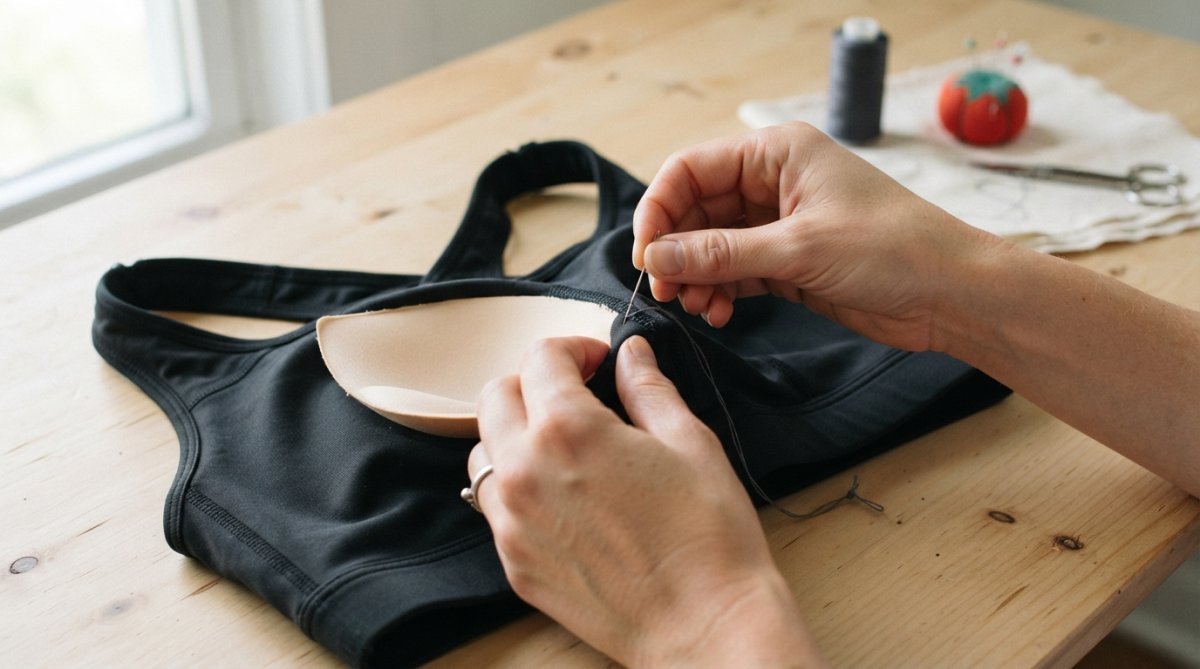
What you'll need:
- Needle and thread matching the bra's interior color
- Straight pins
- Small scissors
Step 1: Remove the pads and mark their position. Take the pads out and place them back inside the bra while you're wearing it. Adjust them to your ideal position, then mark the center of each pad with a pin through the outer fabric.
Step 2: Create a sewing tack. Remove the pads and turn the bra inside out. Where you marked the center, make small tacking stitches that catch both the bra lining and the pad fabric. Two or three stitches at the center point and one at each outer edge of the pad are enough.
Step 3: Secure the edges. The most common mistake is only tacking the center. Add small stitches at the top and bottom edges of each pad to prevent vertical migration.
Step 4: Test the fit. Wear the bra and do a few jumping jacks. If the pads stay put, you're done. If they still move, add additional tacks at the sides.
This method preserves the ability to remove pads for washing while keeping them stable during wear. For bras where pads are already sewn in but shift anyway, the original stitching has likely come loose, and re-tacking solves it.
How to Wash Sports Bras With Pads Without Ruining Them
Washing is where most sports bra pads get damaged, yet it's the easiest variable to control. The less agitation and heat your sports bras experience, the longer the pads will hold their shape and stay in place.
Follow this routine for best results:
- Always remove removable pads before washing
- Fasten any hooks or clasps to prevent snagging
- Place bras in a mesh wash bag
- Use the gentle cycle with cold water
- Never use fabric softener, which breaks down elastic and reduces fabric friction
- Air dry flat, never in the tumble dryer
Hand washing is even gentler: fill a basin with cold water and a small amount of sports detergent, soak for a few minutes, then gently squeeze rather than wring. Rinse and press out excess water with a towel before laying flat to dry.
The structural integrity of your bra depends on this routine. Heat from the dryer degrades elastic and foam, which is why garment care guidance from cleaning experts consistently advises against machine drying anything with foam or structured padding. A bra that loses its shape will never hold pads in place, no matter how well you secure them.
When the Bra Itself Is the Problem: Best Sports Bras for Large Chests
Sometimes the fix isn't the pads, it's the bra. For women with larger chests, removable pads in standard sports bras are often too small or too thin to provide meaningful coverage. The pad migrates because there's not enough structure around it. Before buying a new bra, diagnose why the current one is failing, often the bra's encapsulation structure is weak, not the pad itself.
Diagnosing the Root Cause: Fit vs. Design
Before abandoning a bra, ask yourself these two questions:
- Does the bra's underband sit perfectly horizontal? If it rides up in the back, the entire bra is shifting, which will inevitably move the pads. If this is the case, the bra is the wrong size, not a pad problem. You need to go down a band size and up a cup size.
- When you do a jumping jack, does your breast tissue move independently of the bra? If yes, the bra is relying on the pad for compression, which it can't provide. This is a design failure for high-impact activity.
If the band is stable but the pads still move, the issue is the pad-to-pocket ratio. A bra designed for a B-cup has a small pocket; if you're a D-cup, the pad floats in a pocket that's too large, allowing it to slide. A larger pad isn't the answer, a bra with different construction is.
The Construction-First Approach
For larger chests, the best sports bras prioritize construction over removable padding. Key features to look for include:
- Compression or encapsulation design that supports breast tissue directly rather than relying on pads. Encapsulation (where each breast is cradled in its own cup) is generally more effective for larger sizes.
- A wider underband (at least 2-3 inches) for stable anchoring. The band should be the primary source of support, not the straps.
- Higher-tensile fabric that maintains its shape through washes. Look for fabrics with a high percentage of nylon or a specific 'high-support' designation from the manufacturer.
- Molded or foam-lined cups where the pad is fused to the outer shell. This is a key differentiator. Many premium bras use a 'molded cup' where the foam is permanently bonded to the fabric, eliminating the pocket and the shifting problem entirely.
The 'Pad-Free' Exit Strategy: A Review of What to Look For
If you're done with removable pads, find a bra that provides shape and coverage through its structure alone. Look for these features in a non-padded sports bra that still offers a smooth silhouette:

- Molded Seamless Cups: Look for bras that are described as 'molded' or 'seamless.' These have a pre-formed shape that doesn't rely on an insert. The fabric itself is thicker and holds its shape.
- Layered Knit Construction: Some bras use a double or triple layer of knit fabric in the cup area to provide opacity and shape without a pad. This is a good option for lighter workouts.
- Strategic Seaming: Seams that run horizontally or diagonally across the bust can provide shape and lift without padding. They create structure by shaping the fabric around the breast.
This is where design choices matter. A bra that uses encapsulation design principles for high-impact support distributes support across the entire structure rather than depending on a removable insert. At SheRoar by Black Lion, our Seamless Push-Up Sports Bra eliminates the shifting problem entirely through its seamless knit construction and shock-absorbing support, which holds through high-impact movement without padding that moves. The push-up design adds shape through construction, not through bulky removable pads.
For those who prefer the adjustability of removable pads, the Breathable Racerback Sports Bra offers a lighter option where the racerback cut keeps straps secure and the cotton blend provides natural fabric friction that helps pads stay put.
| Bra Type | Best For | Pad Security | Support Level |
|---|---|---|---|
| Seamless push-up | High-impact workouts | No removable pads to shift | Shock-absorbing |
| Nylon/spandex | Yoga and running | Built-in structure | Medium-high |
| Cotton racerback | Light cardio, daily wear | Natural fabric friction | Light-medium |
| Cross-back | Running, HIIT | Even support distribution | High |
Common Mistakes That Make Pad Shifting Worse
Several habits make pad migration worse without you realizing it. The most common is putting bras in the tumble dryer, which warps both the foam pads and the bra's elastic. Once the bra's shape is compromised, no amount of re-inserting pads will restore a secure fit.
Another frequent error is folding pads when storing bras. Pads stored flat or rolled develop creases that never fully smooth out, creating weak points where the pad naturally wants to fold during wear. Store bras flat or hanging, with pads smoothed into their natural dome shape.
A third mistake is choosing the wrong pad size when replacing lost or damaged pads. Generic replacement pads rarely match the exact dimensions of the original liner pocket, a pad that's too small slides freely; one that's too large buckles and creases. Measure the pocket and the original pad carefully, or consider bras that don't rely on removable padding at all.
Final Thoughts on Stopping Sports Bra Pads Shifting
Pad migration is solvable, but the right fix depends on the root cause. Start with the washing routine, since it's the most common culprit and the easiest change. If pads still shift during wear, move to temporary fixes like lingerie tape, then consider permanent sewing tacks for bras you love. If you're tired of managing pads altogether, look for bras designed without them.
The deeper lesson is that your sports bra should support you, not demand your attention. When a bra fits properly and is constructed for your activity level, you forget you're wearing it. That's the standard every piece of activewear should meet.
At SheRoar by Black Lion, we build our sports bras around this principle. Our collection features seamless and cross-back designs that stay in place through runs, HIIT sessions, and yoga flows, with construction that addresses the pad-shifting problem. Explore the sports bra collection and find the support your workouts deserve.
Frequently Asked Questions
How to stop bra pads from moving during a workout?
The most reliable way to stop bra pads from moving during a workout is to sew them in place. Use a few small stitches through the pad and the inner fabric of the bra, near the center and sides. For a temporary fix, apply double-sided lingerie tape to the back of the pad before inserting it. Also, ensure you're wearing the correct size; a too-loose band allows excess movement that shifts the pads.
Should I remove bra pads before washing?
Yes, you should remove bra pads before washing if they are removable. Washing them inside the bra, even in a mesh laundry bag, can cause them to bunch, fold, or tear. Hand wash the pads separately with mild detergent and let them air dry flat. This keeps their shape and prevents the shifting and misshapen look that happens when pads are washed inside the bra.
How can I permanently secure pads in a sports bra?
To permanently secure pads in a sports bra, you'll need to sew them. Turn the bra inside out, position the pad correctly, and use a needle and thread to make a few small tacking stitches through the pad and the bra's inner lining. Secure the corners and the center edge. This is the most effective way to stop sports bra pads shifting permanently. A seamstress can also do this for you.
What sports bras have pads that don't move?
Sports bras with sewn-in pads or those made with molded, non-removable cups are your best option. Look for styles described as 'seamless' or with a 'fixed cup' construction. For example, a seamless push-up sports bra with a knit construction helps hold its shape and reduces the likelihood of separate padding shifting. For larger chests, a bra with encapsulation support and a firm band will hold everything in place better.
The frustration of shifting pads is real, but it's rarely a reason to give up on a bra. Whether you need a quick tape fix, a permanent sewing solution, or a bra designed without removable pads entirely, you now have the tools to work out without adjustment breaks. Your focus belongs on your training, not on what's happening inside your bra.