How to Choose High Quality Activewear for Women Over 40

Table of Contents
- What You'll Need Before You Buy Activewear for Women Over 40
- Key Features to Look for in High Quality Activewear
- Best Moisture-Wicking Fabrics for Sensitive Skin
- Benefits of Compression Leggings for Women Over 40
- How to Prevent Chafing During High-Intensity Workouts
- How Should Activewear Fit as Your Body Changes After 40?
- Menopause, Joint Support and Athleisure Styling: What Most Guides Miss
- Conclusion: Dress for the Body You Have Now
- Frequently Asked Questions
Last Updated: September 16, 2026
What You'll Need Before You Buy Activewear for Women Over 40
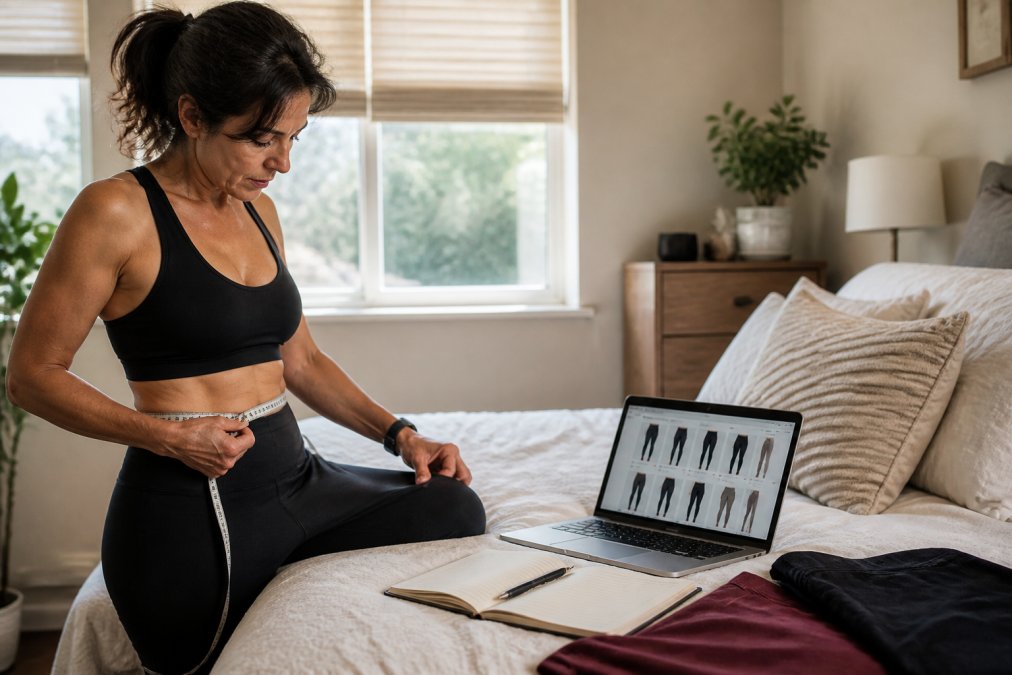
Choosing activewear for women over 40 starts with three honest measurements: your current bust, waist and hip, taken with a soft tape against bare skin, not over old leggings. At SheRoar by Black Lion, we see the same pattern in customer questions again and again: women buy the size they wore at 35, then blame the garment when it slides, digs or turns transparent.
Before you spend anything, gather four things:
- A soft measuring tape and your actual current numbers
- A note of your dominant workout type, low-impact or high-impact
- One old pair of leggings you can compare fabric against
- A list of the movements you do most, such as squats, lunges or overhead presses
That list matters more than any brand label.
Key Features to Look for in High Quality Activewear
The features that separate good activewear from expensive activewear are fabric composition, stretch direction, seam type and opacity under tension. Everything else, including colour and branding, is preference.
Fabric Composition and Four-Way Stretch
Four-way stretch means the fabric extends both across and down the garment, so it moves with you rather than pulling against you. Look for a polyester-spandex or nylon-spandex blend, because the spandex content is what gives the fabric its recovery. A common mistake is judging leggings by feel alone in the fitting room. Stretch them sideways and lengthways, then let go and watch whether the fabric snaps back or sags.
Flatlock Seams and Chafe-Resistant Construction
Flatlock seams are stitched flat against the fabric instead of raised, which removes the ridge that rubs during repeated movement. On the inside of a good legging you should see a smooth, wide seam rather than a narrow overlocked edge. Chafe-resistant construction also means no bulky side pockets sitting directly under a hip strap.
Best Moisture-Wicking Fabrics for Sensitive Skin
The best moisture-wicking fabrics for sensitive skin are smooth, fine-gauge synthetic blends, typically polyester-spandex or nylon-spandex, engineered to pull sweat off the skin and spread it across the surface of the fabric so it evaporates quickly. That two-step process, transport then evaporation, is what separates a true performance knit from a cotton tee that simply holds dampness against the body.
Wicking vs. Quick-Drying: They Are Not the Same Thing
A fabric can wick sweat away from the skin and still dry slowly if the knit is too dense. Wicking describes how moisture moves through the fibre; quick-drying describes how fast it leaves the garment. For sensitive skin you want both. A simple in-store test: place a drop of water on the inside of the fabric and watch how fast the dark spot spreads and fades.
Why Menopause Changes the Fabric Equation
Hot flushes and night sweats mean many women over 40 move between feeling overheated and chilled within a single session. That swing is the reason thermally regulated layers matter more than maximum warmth. Look for lightweight, breathable knits that release heat quickly rather than insulating it, and favour fabrics that dry fast so a sweat-soaked layer does not turn cold against the skin when activity stops.
A Quick Fabric Checklist for Sensitive Skin
- Smooth, fine-gauge knit with no visible fuzz or pilling
- Polyester-spandex or nylon-spandex blend with enough spandex for recovery
- Light or undyed colourways if your skin marks easily
- Anti-microbial finish if the garment will sit in a bag between sessions
- No raised seams in contact zones such as the inner thigh or bra band
Benefits of Compression Leggings for Women Over 40
Compression leggings for women over 40 offer graduated pressure that supports muscles and joints during movement, which many women find helpful once natural collagen and elastin levels decline with age.
| Feature | What It Does | Why It Matters After 40 |
|---|---|---|
| Four-way stretch | Moves in all directions | Protects range of motion in hips and shoulders |
| High-waist band | Stays flat, no rolling | Prevents mid-workout adjusting |
| Squat-proof opacity | Holds colour at full depth | Removes see-through worry |
| Moisture-wicking knit | Pulls sweat away | Reduces damp friction on skin |
How to Prevent Chafing During High-Intensity Workouts
Preventing chafing during high-intensity workouts comes down to removing friction, removing moisture and removing seam ridges, in that order.
Three practical steps handle most cases:
Women's High Waist Squat-Proof →
- Choose flatlock seams over raised stitching in every contact zone
- Switch to a moisture-wicking fabric so sweat moves off the skin
- Test the garment through the exact movement you do most before trusting it
How Should Activewear Fit as Your Body Changes After 40?
Activewear should fit your body as it is now, not the size you wore a decade ago. Fit is measured by movement and coverage, not by the number on the label.
Sizing Up for Supportive Fit Without Compression Discomfort
Sizing up is often the correct move, not a compromise. If a legging rolls, slides or digs, going up one size frequently improves support because the fabric can lie flat instead of stretching to its limit.
Menopause, Joint Support and Athleisure Styling: What Most Guides Miss
Most buying guides stop at fabric and fit, and skip the two things that actually change after 40: joint support and the shift from gym to daily wear. This section covers both, because they are the reasons a garment either earns its place in your drawer or sits unworn.
Joint Support and Mobility Integration
Joint support and mobility integration matter because knees, hips and shoulders carry more load when surrounding muscle mass declines. Compression helps, but so does ergonomic design, meaning seams and panels placed where they support rather than restrict. Look for a supportive fit that does not limit range of motion, and avoid garments that pinch at the knee or shoulder.
Building a Capsule Wardrobe That Works Gym to Social
On the styling side, versatility is the real test. A piece that only works in the gym gets worn twice a week. A piece that also works for the school run, the café and the office gets worn constantly, which changes its actual cost per wear. That is the case for athleisure built as a complete outfit rather than a single-purpose garment.
- One solid, high-waist legging in a neutral colour that layers under a blazer or long shirt
- One supportive sports bra that disappears under a normal top
- One relaxed-fit top that reads as a casual shirt outside the gym
- One lightweight layer, such as a zip jacket or wrap, that finishes the outfit
The Sustainability Angle Most Guides Skip
Sustainable and ethical manufacturing is the other gap. Ask how a garment is made, how long it is designed to last and whether the fabric holds its shape through repeated washing. Durability is the most honest sustainability metric in activewear, because a legging that survives two years of washing replaces four that fall apart in six months. A capsule approach, fewer, better pieces worn more often, is both a styling strategy and a sustainability one.

Conclusion: Dress for the Body You Have Now
The hardest part of buying activewear after 40 is not the fabric science. It is the mental shift from dressing for a body you used to have to dressing the body you live in now.
Frequently Asked Questions
What fabric is most moisture-wicking for intense workouts?
Polyester and nylon blends move sweat away from your skin faster than cotton, which holds moisture and feels heavy. Look for moisture-wicking performance fabric with four-way stretch. The Women's High Waist Squat-Proof Performance Leggings use a polyester-spandex blend that pulls sweat away during back-to-back sets, and the Women's Wire-Free Shockproof Yoga Sports Bra uses 90% spandex and Lycra for stretch and recovery.
How should activewear fit as your body changes after 40?
Fit should follow function. A high-waisted band should sit flat without folding during core work, and leggings should stay opaque at the bottom of a squat. The Women's High Waist Squat-Proof Performance Leggings are true to size with a wide tummy control band. If you are between sizes, size up for a supportive fit that still allows full range of motion.
Why is compression important in activewear for women over 40?
Compression supports muscles and joints during low-impact and high-impact movement, which matters more as joint support needs change. Four-way stretch and compression work together to hold shape without restricting range of motion. The Women's Minimalist Form-Fitting Yoga Pants offer a close fit from waist to ankle without compressing through the thigh, which suits sustained effort and daily wear.
How can you tell if activewear is high quality before buying?
Check three things: fabric composition, seam construction and opacity. Look for four-way stretch, flatlock seams and squat-proof fabric. The Women's High Waist Squat-Proof Performance Leggings are tested at full depth and maintain opacity without thinning. The Women's Wire-Free Shockproof Yoga Sports Bra uses wire-free shockproof design with gathering construction that shapes without padding shifting out of place.