Dumbbell Strength Training Routine for Women

Table of Contents
- Why a Dumbbell Strength Training Routine for Women Works
- Beginner Dumbbell Workout for Women: 7 Moves to Master
- Dumbbell Workout Plan for Women 3 Days a Week
- How Much Weight Should a Beginner Lift?
- How to Progress in Strength Training Without Stalling
- Warm-Up, Cooldown, and Recovery for Dumbbell Training
- Modifications for Injuries, Mobility Limits, and Home Equipment
- Conclusion
- Frequently Asked Questions
Last Updated: October 17, 2026
Why a Dumbbell Strength Training Routine for Women Works
A dumbbell strength training routine for women works because dumbbells let you load real strength work at home, in a gym, or in a corner of a bedroom, with no machine queue and no spotter. This guide from SheRoar by Black Lion walks you through seven foundational moves, a three-day weekly plan, and the weight-selection rules most beginner guides skip.
Here is the part that changes everything: you do not need a rack of fifteen dumbbells. You need two pairs, one light and one moderate, plus a plan you repeat long enough to progress.
Beginner Dumbbell Workout for Women: 7 Moves to Master
Seven moves cover your entire body: goblet squat, reverse lunge, Romanian deadlift, chest press, overhead press, row, and biceps curl. Master these before adding variety. A beginner dumbbell workout for women should feel almost boring for the first month, and that repetition is the point.
Lower Body: Goblet Squat and Reverse Lunge
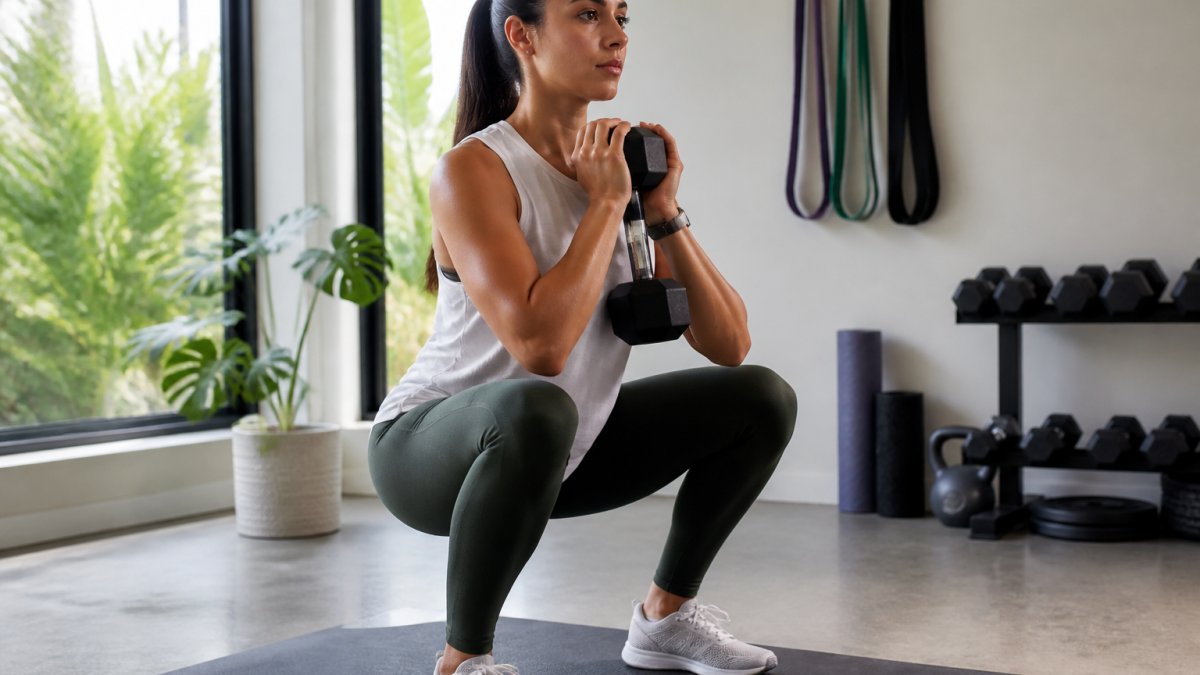
The goblet squat teaches the squat pattern with the weight in front, which keeps your chest up and your knees tracking over your toes. Hold one dumbbell vertically at your chest, sit down between your heels, and stand. Three sets of 8 to 12 reps.
The reverse lunge trains each leg alone, which exposes the side-to-side strength gap most beginners do not know they have. Step back, lower until the front thigh is roughly parallel to the floor, and drive up through the front foot. Two to three sets of 8 per leg.
Hip Hinge: Romanian Deadlift
The Romanian deadlift is the best teacher of the hip hinge, the movement pattern behind picking up anything heavy without hurting your back. Hold a dumbbell in each hand, soften the knees, push your hips back, and lower the weights along your shins until you feel a stretch in your hamstrings. Stand tall by squeezing your glutes. Three sets of 8 to 10.
Upper Body Push and Pull: Chest Press, Overhead Press, Row, Biceps Curl
Four upper-body moves balance the pushing and pulling that keeps shoulders healthy. The chest press (lying on a bench or floor) builds pressing strength. The overhead press trains shoulders and trunk together. The one-arm row builds the back muscles that posture depends on. The biceps curl is the simplest of the four and the easiest to load progressively.
| Move | Pattern | Sets x Reps | What It Trains |
|---|---|---|---|
| Goblet squat | Squat | 3 x 8-12 | Quads, glutes, core |
| Reverse lunge | Single-leg | 2-3 x 8/leg | Glutes, quads, balance |
| Romanian deadlift | Hip hinge | 3 x 8-10 | Hamstrings, glutes, back |
| Chest press | Horizontal push | 3 x 8-12 | Chest, triceps, shoulders |
| Overhead press | Vertical push | 3 x 8-10 | Shoulders, triceps, core |
| One-arm row | Horizontal pull | 3 x 10/arm | Back, biceps |
| Biceps curl | Elbow flexion | 2-3 x 10-12 | Biceps, forearms |
Dumbbell Workout Plan for Women 3 Days a Week
A three-day dumbbell workout plan for women splits the week into full-body sessions on non-consecutive days, which gives each muscle group roughly 48 hours to recover. Monday, Wednesday, and Friday is the classic layout. Tuesday, Thursday, and Saturday works just as well.
Each session runs 30 to 45 minutes: five minutes of warm-up, 25 to 35 minutes of lifting, and five minutes of cooldown. Run all seven moves in each session for the first four weeks. After that, you can shift to an upper/lower split if you prefer shorter sessions.
| Day | Session | Focus | Duration |
|---|---|---|---|
| Monday | Full body A | Squat, press, row | 35-45 min |
| Tuesday | Rest or walk | Recovery | 20-30 min |
| Wednesday | Full body B | Hinge, lunge, pull | 35-45 min |
| Thursday | Rest or mobility | Recovery | 15-20 min |
| Friday | Full body C | Squat, press, curl | 35-45 min |
| Weekend | Rest | Full recovery | , |
How Much Weight Should a Beginner Lift?
Start with a weight you can lift for 12 clean reps but not 15. That is the honest answer, and it beats any chart. If you cannot complete 8 reps with good form, the dumbbell is too heavy. If you finish 12 reps and could easily do 5 more, it is too light.
For most women starting out, that means a light pair and a moderate pair. Use the light pair for overhead presses and curls, the moderate pair for squats, hinges, and rows. Expect to outgrow the light pair within weeks.
How to Progress in Strength Training Without Stalling
Progression in strength training follows one rule: make the exercise slightly harder over time.
Weeks 1-2: Establish your baseline. Use the light pair for every lift.
Weeks 3-4: Add reps. Stay with the same dumbbells but increase to 3 sets of 8-10 reps.
Weeks 5-6: Add weight and drop reps. Move up to the moderate pair on the lifts where you hit 10 reps.
Weeks 7-8: Consolidate and push. Work from 8 reps back up to 10-12 with the moderate pair.
Sports Fitness Gloves for Yoga, Weightlifting & Training →
Warm-Up, Cooldown, and Recovery for Dumbbell Training
Most dumbbell routines for women jump straight to the exercises. That is a mistake.
The five-minute warm-up. Do not stretch cold muscles. Instead, move through a sequence that raises your heart rate and takes your joints through their full range:
- March in place or walk briskly for 2 minutes. This raises core temperature and gets blood moving.
- Arm circles, 10 forward and 10 backward. Loosens the shoulders for pressing and rowing.
- Bodyweight squats, 10 reps. Opens the hips and ankles for goblet squats and lunges.
- Hip hinges with no weight, 10 reps. Rehearses the Romanian deadlift pattern before you load it.
- Cat-cow stretch, 5 slow reps. Mobilizes the spine for hinging and pressing.
Then, before your working sets on each exercise, do one set with the light dumbbell at half the reps you plan to use.
The five-minute cooldown. After your last set, bring your heart rate down gradually:
- Walk or march in place for 2 minutes.
- Hold a static stretch for each major muscle group you trained, 20-30 seconds per side. Focus on the areas that feel tightest, usually hips, hamstrings, and chest after this routine.
- Take five slow breaths with a long exhale. This signals your nervous system to shift into recovery mode.
Recovery between sessions. Recovery is not passive, it is the part of the plan where your muscles actually rebuild. Three things matter most:
- Sleep. Most adults need seven to nine hours. If you are training three days a week and not sleeping, you are borrowing against progress you will have to repay with a stall or an injury.
- Protein and hydration. Aim for a source of protein at each meal and drink water throughout the day. You do not need to count grams to benefit, just do not skip meals on training days.
- Active recovery on rest days. A 20-30 minute walk on Tuesday and Thursday does more for soreness than lying on the couch. Movement increases blood flow to recovering muscles without adding training stress.
Soreness vs. pain. Soreness that fades within 48 hours is normal, especially in weeks 1-2. Sharp pain during a lift is not, it means stop and reassess. If a joint hurts during a movement, swap to a modification (see the next section) rather than pushing through.
Modifications for Injuries, Mobility Limits, and Home Equipment
Every one of the seven moves has a substitute. Swap the goblet squat for a box squat if your knees complain on depth. Replace the Romanian deadlift with a hip bridge if your lower back is sensitive. Press on the floor instead of a bench if shoulders pinch.
If you train at home with limited kit, resistance bands cover the pulling work well. The Foot Pedal Resistance Band anchors under your foot so both hands stay free for rows and curls, with five color-coded resistance levels from 15 to 35 lbs. The 6-Tube Foot Pedal Resistance Band Set adds handles for bilateral pulling.


Grip is the quiet limiter on dumbbell work. The Sports Fitness Gloves use a reinforced palm grip to protect your hands and improve hold, which matters once rows and hinges get heavy.

Conclusion
The hardest part of dumbbell training is not the lifting. It is showing up three times a week for eight weeks with the same seven moves and slightly heavier weights. Most people quit in week three, right before the results arrive.
At SheRoar by Black Lion, we build activewear for exactly that stretch of the process: the Dumbbell Graphic Print Sleeveless Tank Top gives you full arm range for pressing and pulling, and our SheRoar Fitness resources pair workout videos with tips for beginners. See the catalog and dress the woman you are becoming.
Frequently Asked Questions
What is a good starting weightlifting routine for a woman?
Start with a full-body dumbbell routine three days a week, covering a squat, hip hinge, push, pull, and carry. Do 2-3 sets of 8-12 reps per move with a weight you can lift with clean form. Add 2.5 to 5 pounds only when the last two reps feel challenging but controlled. This dumbbell strength training approach builds muscle strength without overwhelming a beginner.
How much weight should a female beginner lift?
There is no single number because it depends on the exercise and your current strength. For goblet squats and Romanian deadlifts, many beginners start with 10 to 20 pounds; for biceps curls and lateral raises, 5 to 10 pounds. Choose a weight where the final two reps of a set are hard but your form stays solid. If you can breeze through 12 reps, go heavier. If form breaks by rep six, go lighter.
How many days a week should women do dumbbell strength training?
Three days a week is the sweet spot for most beginners. A dumbbell workout plan for women 3 days a week gives each muscle group enough stimulus while leaving 48 hours between sessions for recovery. If you are new to lifting, start with two days and add a third after two to three weeks. More is not better if you cannot recover.
Can you build strength with dumbbells at home?
Yes. Dumbbells load every major muscle group and let you progress by adding weight, reps, or sets. A pair of adjustable dumbbells plus a bench or sturdy chair covers squats, presses, rows, and hinges. Add a resistance band set for pulling angles and you have a complete home gym. Consistency and progressive overload matter more than the equipment brand.
How should women progress their dumbbell workouts?
Use progressive overload in small steps. When you hit the top of your rep range (12 reps) on every set with good form, increase the weight by the smallest increment available, usually 2.5 to 5 pounds. If you cannot add weight, add one rep per set or one extra set. Track your lifts in a notebook or phone app so you know when to push.